

1. The Importance of Data in a Smart City
A smart city is an urban area designed to be more sustainable, livable, and inclusive by improving how resources are managed and how people move, live, and interact within it. At the core of this is the use of digital technologies and data-driven technologies to improve the lives of its citizens1City Council of Barcelona, “Rethink the smart city,” Ajuntament de Barcelona, accessed November 16, 2025, https://www.barcelona.cat/metropolis/en/contents/rethink-the-smart-city. In this way, technology becomes a tool to support broader objectives of sustainability, wellbeing, and participation for all citizens and includes making services more efficient, saving energy, protecting the environment, and streamlining administrative processes. To achieve all this, one essential element is needed: reliable, current, and systematically collected data.
Without data, city administrations lack the basis to understand where problems exist, when and where resources are needed, or which actions have measurable effects. For example, if traffic frequently backs up at a particular intersection, this can only be verified through data, such as sensor-based vehicle counts2U.S. Department of Transportation, “Traffic Monitoring Guide,” Federal Highway Administration, accessed November 16, 2025, https://highways.dot.gov/safety/data-analysis-tools/rsdp/rsdp-tools/traffic-monitoring-guide-tmg. Or, if air quality is poor in one part of the city, fine dust sensors can help identify the causes and guide effective interventions3World Health Organization, “Ambient air pollution,” World Health Organization, October 24, 2024, https://www.who.int/news-room/fact-sheets/detail/ambient-(outdoor)-air-quality-and-health.

FIG. https://www.vvdntech.com/blog/navigating-the-smart-city-domains-a-comprehensive-guide/
Data also fosters greater transparency and participation in urban planning. Through open data platforms, interested citizens can access key public information, such as energy use, traffic patterns, or environmental readings. This transparency enhances public engagement and builds trust in local government.
In this sense, smart cities not only improve daily urban life but also contribute directly to larger global initiatives such as the UN’s Agenda 2030 and the Paris Agreement4United Nations, “The Sustainable Development Agenda,” United Nations, accessed November 16, 2025, https://sdgs.un.org/goals. By using data to cut emissions, improve energy efficiency, and promote sustainable mobility, cities help achieve Sustainable Development Goal 11 (Sustainable Cities and Communities) and Goal 13 (Climate Action), while also supporting related goals like Goal 7 (Affordable and Clean Energy). In this way, international climate and development objectives are turned into concrete local action that citizens can see and experience in their own neighborhoods.
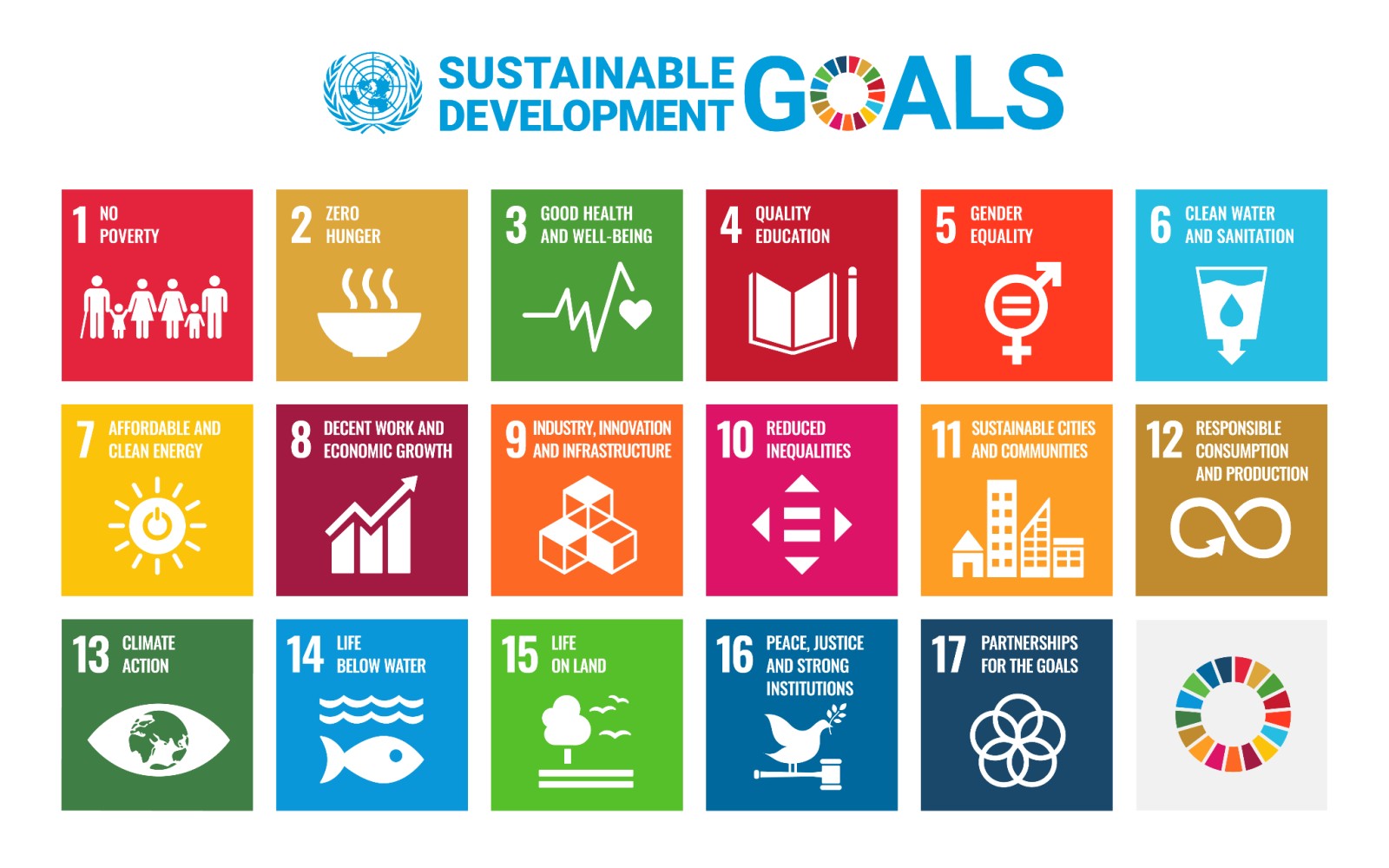
FIG. https://www.globalcompact.de/en/our-work/sustainable-development-goals-1
2. The Technical Cycle of Data Collection
The journey from problem detection to concrete improvement in a Smart City follows a technical cycle.
At the beginning is sensor technology. Sensors are small devices that measure specific types of data, such as temperature, air quality, noise levels, or motion. They act as the “eyes” and “ears” of the digital city5The Institution of Engineering and Technology, “Data collection in IoT networks: Architecture, solutions, protocols and challenges,” June 4, 2024, https://ietresearch.onlinelibrary.wiley.com/doi/10.1049/wss2.12080. Strategic placement throughout urban areas allows for meaningful data collection.
The most widespread device that could generate data is the smartphone. Citizens of a city can enter observations and report issues in a dedicated app and thus act as human sensors in a smart city.
The collected data must then be transmitted, from the sensor to a central processing unit or cloud system. There, the data is stored, processed, and analysed. Only through this processing does the raw data become actionable knowledge6McKinsey & Company, “The Internet of Things: Catching up to an accelerating opportunity,” McKinsey & Company, accessed November 16, 2025, https://sitic.org/wordpress/wp-content/uploads/The-Internet-of-Things-Catching-up-to-an-accelerating-opportunity.pdf. Based on the findings, city officials can make informed decisions, such as implementing new traffic routing, smart traffic lights, or warning systems.
This cycle of Collecting – Transmitting – Analysing – Deciding forms the backbone of any digital Smart City infrastructure7Cisco, “The Data Value Chain in Smart Cities,” Cisco, accessed November 16, 2025, https://www.cisco.com/c/dam/global/en_in/assets/pdfs/idc-whitepaper-smartest-cities-of-the-future.pdf.
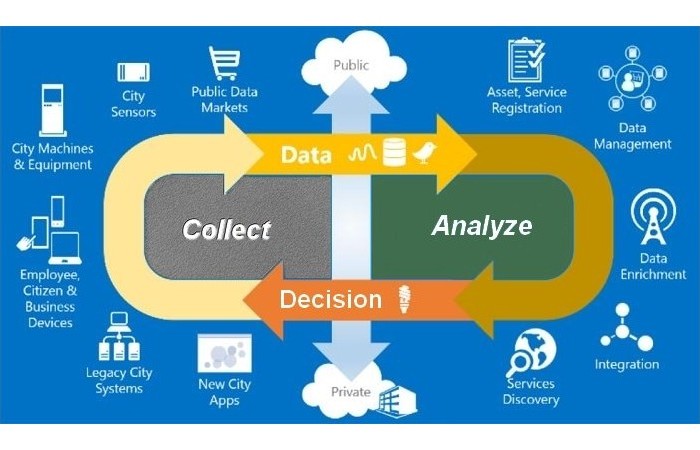
FIG. https://www.researchgate.net/figure/Big-Data-for-smart-city_fig3_320662287
3. Technologies for Data Transmission: Options, Advantages, and Disadvantages
Choosing the right data transmission technology is a critical aspect of any Smart City initiative. The information collected by sensors must be transmitted securely, efficiently, and reliably to be useful. There are several technologies available, each suited to different use cases and environments8IEEE Internet of Things Journal, “A Survey on Communication Technologies for Smart Cities,” IEEE Xplore, accessed November 16, 2025, https://ieeexplore.ieee.org/document/9806180.
WLAN (WiFi)
WiFi is well-suited for areas with existing infrastructure, such as public buildings, schools, or transport hubs. It supports high data transfer rates and is widely available. However, WiFi has limited range and requires a constant power source, which makes it less practical for remote or mobile sensors.
Mobile Networks (4G/5G)
Cellular networks, particularly 5G, offer very high speeds and are ideal for transmitting large volumes of data in real time. This makes them useful for mobile applications such as connected vehicles or traffic monitoring. Downsides include ongoing service costs, variable coverage, and higher power consumption for devices using mobile modems.
LPWAN (e.g., LoRaWAN, NB-IoT)
Low Power Wide Area Networks (LPWAN) like LoRaWAN or NB-IoT are specifically designed for the Internet of Things (IoT). These networks allow cost-effective, energy-efficient transmission of small data packets over long distances. They are perfect for low-bandwidth tasks such as air quality monitoring or smart waste collection. However, they cannot handle large data volumes or media content and have limited speed.
Bluetooth and BLE
Bluetooth Low Energy (BLE) is suitable for short-range communication, such as inside buildings. It is extremely energy-efficient and useful for applications like door sensors, room monitoring, or indoor asset tracking. However, BLE’s short range makes it unsuitable for city-wide coverage.
Wired Connections
Wired technologies, such as LAN or fiber optic cables, provide the most reliable and secure connection. They are ideal for permanent infrastructure like government buildings, control centers, or traffic light systems. However, they require costly installation and are not flexible for mobile or dispersed sensor setups.
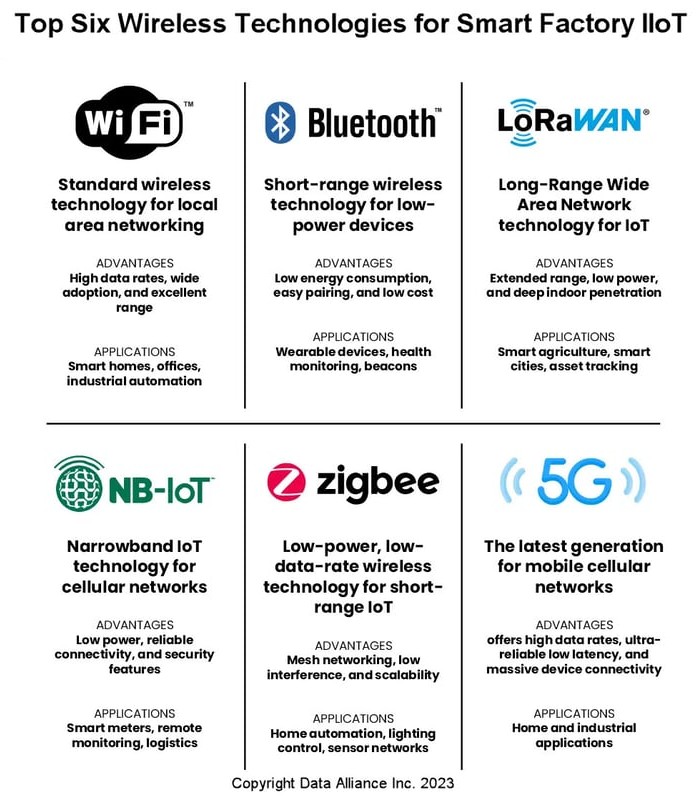
FIG. https://www.data-alliance.net/blog/smart-factory-iot-top-six-wireless-connectivity-solutions/
4. Technology and Citizen Participation
Digital technologies can make it much easier for people to take part in public life and decisions in their city. A common way to do this is through smartphone apps, but there are also many other tools. For example, public display screens, websites, and even smart sensors can be used to collect ideas or feedback from citizens. In some places, interactive stations are installed in public spaces where people can vote on local projects or report issues like broken lights or litter9Berg Insight. “Smart Cities: Connected Public Spaces,” BergInsight.com. accessed November 16, 2025, https://media.berginsight.com/2024/04/09142653/bi-smartcities3-ps.pdf. Sensors can help too, for example, noise sensors can show areas where citizens often complain about traffic or loud events, helping the city respond more quickly.
A great example from Europe is the app Decidim, which was first developed in Barcelona, Spain10Decidim Website, “About Decidim,” Decidim, accessed November 16, 2025, https://decidim.org/about. It is a digital platform that allows citizens to propose ideas, discuss city plans, vote on projects, and track what the local government is doing. It is open-source, which means other cities can also use and improve it. Decidim has been praised for being transparent, secure, and giving real power to the people in city decisions11United Nations. “Decidim: a multipurpose open source platform for e-participation,” United Nations. accessed November 16, 2025, https://publicadministration.desa.un.org/good-practices-for-digital-government/compendium/decidim-multipurpose-open-source-platform-e. It is now used in several European cities and is a strong example of how technology can help build trust and participation in communities.
Decidim Video Ad (YouTube)
5. Digital Twins: The Virtual Copy of the City
A digital twin is one of the most advanced tools used in a Smart City. It is a complete, virtual (computer-based) model or copy of a physical thing, a system, or even the entire city. It is called a “twin” because it mirrors the real world exactly12Gartner, “Digital Twin,” Gartner, accessed November 16, 2025, https://www.gartner.com/en/information-technology/glossary/digital-twin.
This virtual copy is brought to life by the vast amounts of real-time data collected by the city’s sensors and systems. Everything that happens in the real, physical city, like a traffic light changing, a bus moving, or the air quality dropping, is immediately updated inside the digital twin.
The main purpose of a digital twin is to create a safe, risk-free laboratory for the city. City planners can use this virtual environment to experiment and make predictions before making expensive or large-scale changes in the real world13NVIDIA, “What Is a Digital Twin?,” NVIDIA, accessed November 16, 2025, https://www.nvidia.com/en-us/glossary/data-science/digital-twin/.
Digital Twin explained by Georgia Tech (YouTube Video)
The benefits are huge:
- Testing Scenarios: Instead of hoping a new idea works, city officials can test it first. For example, they can see in the virtual twin if changing the timing of a major intersection’s traffic lights will truly reduce travel time for commuters.
- Predicting the Future: By feeding the model with current data and historical patterns, the twin can help predict problems. For instance, it can show city engineers which neighbourhoods will be most affected by a future flood or how a planned heatwave will impact the city’s energy grid.
- Better Resource Management: The twin helps visualise where resources are needed most. If a fire starts in the virtual city, the twin can instantly show the fastest routes for emergency vehicles, taking into account current traffic and road closures.
In short, a digital twin turns a city’s raw data into a powerful tool for planning, allowing for smarter, faster, and more informed decisions about urban life.
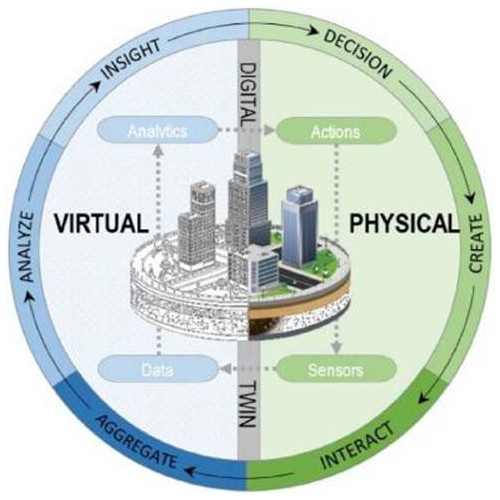
FIG. https://www.sciencedirect.com/science/article/pii/S2210670724004086
6. Conclusion
Developing a Smart City requires a well-thought-out strategy for managing data and digital infrastructure. In order for cities to make informed decisions, they must invest in systematic data collection powered by appropriate technologies. The choice of transmission method depends on several factors: What is being measured? Where? How frequently?
Bibliography
- Berg Insight. “Smart Cities: Connected Public Spaces”, BergInsight.com, 2025, https://media.berginsight.com/2024/04/09142653/bi-smartcities3-ps.pdf
- “The Data Value Chain in Smart Cities”, Cisco, 2025, https://www.cisco.com/c/dam/global/en_in/assets/pdfs/idc-whitepaper-smartest-cities-of-the-future.pdf
- City Council of Barcelona. “Rethink the smart city”, Ajuntament de Barcelona, 2025, https://www.barcelona.cat/metropolis/en/contents/rethink-the-smart-city
- Decidim Website. “About Decidim”, Decidim, 2025, https://decidim.org/about
- “Digital Twin”, Gartner, 2025, https://www.gartner.com/en/information-technology/glossary/digital-twin
- IEEE Internet of Things Journal. “A Survey on Communication Technologies for Smart Cities”, IEEE Xplore, 2025, https://ieeexplore.ieee.org/document/9806180
- Institution of Engineering and Technology. “Data collection in IoT networks: Architecture, solutions, protocols and challenges”, IET, 2024, https://ietresearch.onlinelibrary.wiley.com/doi/10.1049/wss2.12080
- McKinsey & Company. “The Internet of Things: Catching up to an accelerating opportunity”, McKinsey & Company, 2025, https://sitic.org/wordpress/wp-content/uploads/The-Internet-of-Things-Catching-up-to-an-accelerating-opportunity.pdf
- “What Is a Digital Twin?”, NVIDIA, 2025, https://www.nvidia.com/en-us/glossary/data-science/digital-twin/
- United Nations. “Decidim: a multipurpose open source platform for e-participation”, United Nations, 2025, https://publicadministration.desa.un.org/good-practices-for-digital-government/compendium/decidim-multipurpose-open-source-platform-e
- United Nations. “The Sustainable Development Agenda”, United Nations, 2025, https://sdgs.un.org/goals
- S. Department of Transportation. “Traffic Monitoring Guide”, Federal Highway Administration, 2025, https://highways.dot.gov/safety/data-analysis-tools/rsdp/rsdp-tools/traffic-monitoring-guide-tmg
- World Health Organization. “Ambient air pollution”, World Health Organization, 2024, https://www.who.int/news-room/fact-sheets/detail/ambient-(outdoor)-air-quality-and-health