

Waste Management in Cities
Subtopics:
Every year, across the globe, more than two billion tonnes of municipal solid waste (MSW) is generated. If packed into standard shipping containers and placed end-to-end, this waste would wrap around the Earth’s equator 25 times 1UNEP, Global Waste Management Outlook 2024: Beyond an Age of Waste – Turning Rubbish into a Resource, 2024, https://wedocs.unep.org/items/36e16872-2f02-4447-a3c1-c939bf50ea92.
As well as municipal waste, human activity generates significant amounts of agricultural, construction and demolition, industrial and commercial, and healthcare waste. This waste is produced on farms, building sites and in factories and hospitals.
Municipal waste is generated wherever there are human settlements. It is influenced by each person in the world, with every purchasing decision, through daily practices and in the choices made about managing waste in the home. The way people buy, use and discard materials determines the amount of energy and raw materials used and how much waste is generated. The generation of municipal waste is closely linked to the GDP of a country and varies greatly across the globe, as can be seen in the graph below depicting both total and per capita waste of selected regions 2UNEP, 2024.
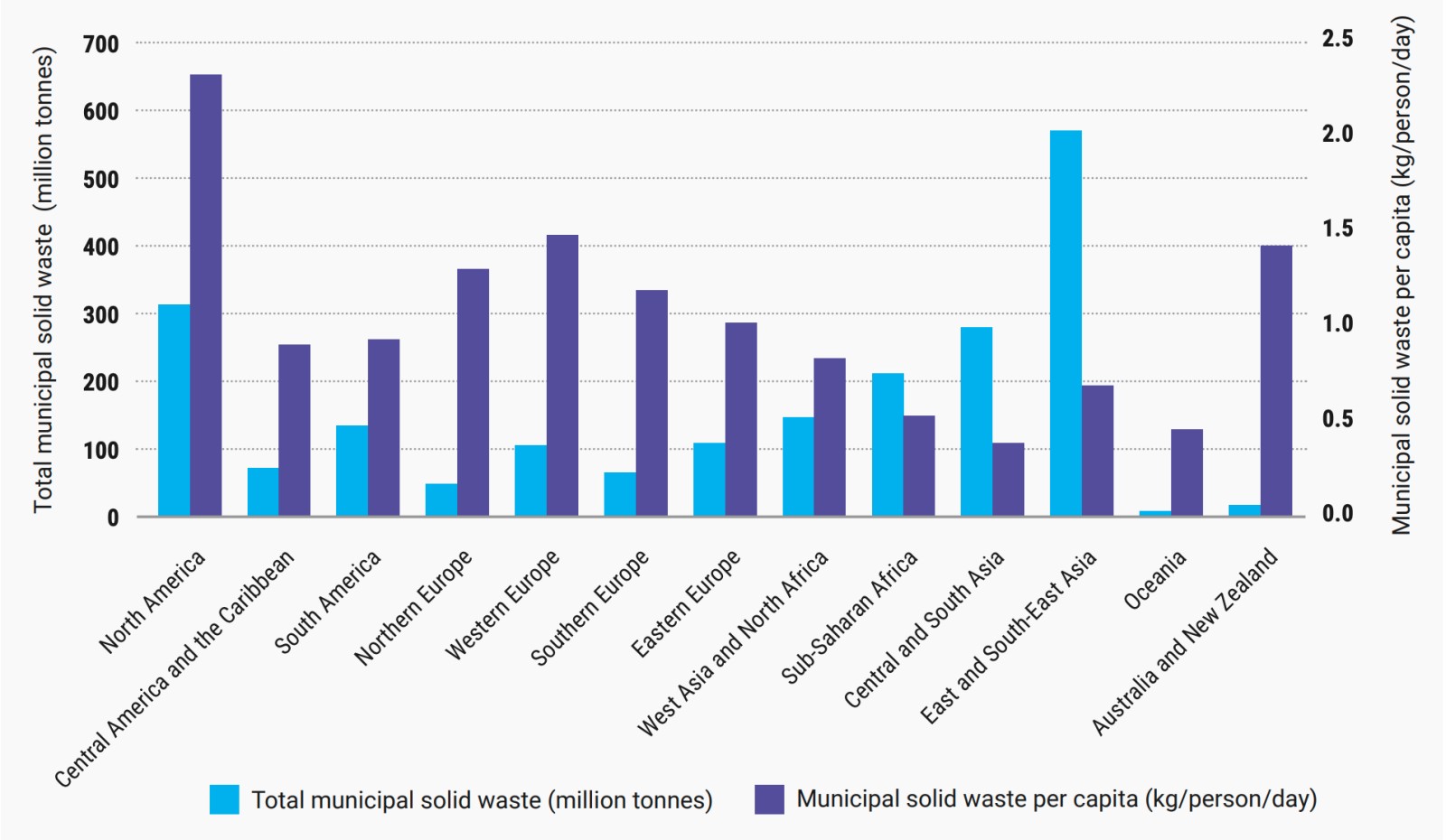
FIG. Municipal Solid Waste (MSW) generation by Region, Total MSW (million tonnes) and MSW per capita 3UNEP, 2024.
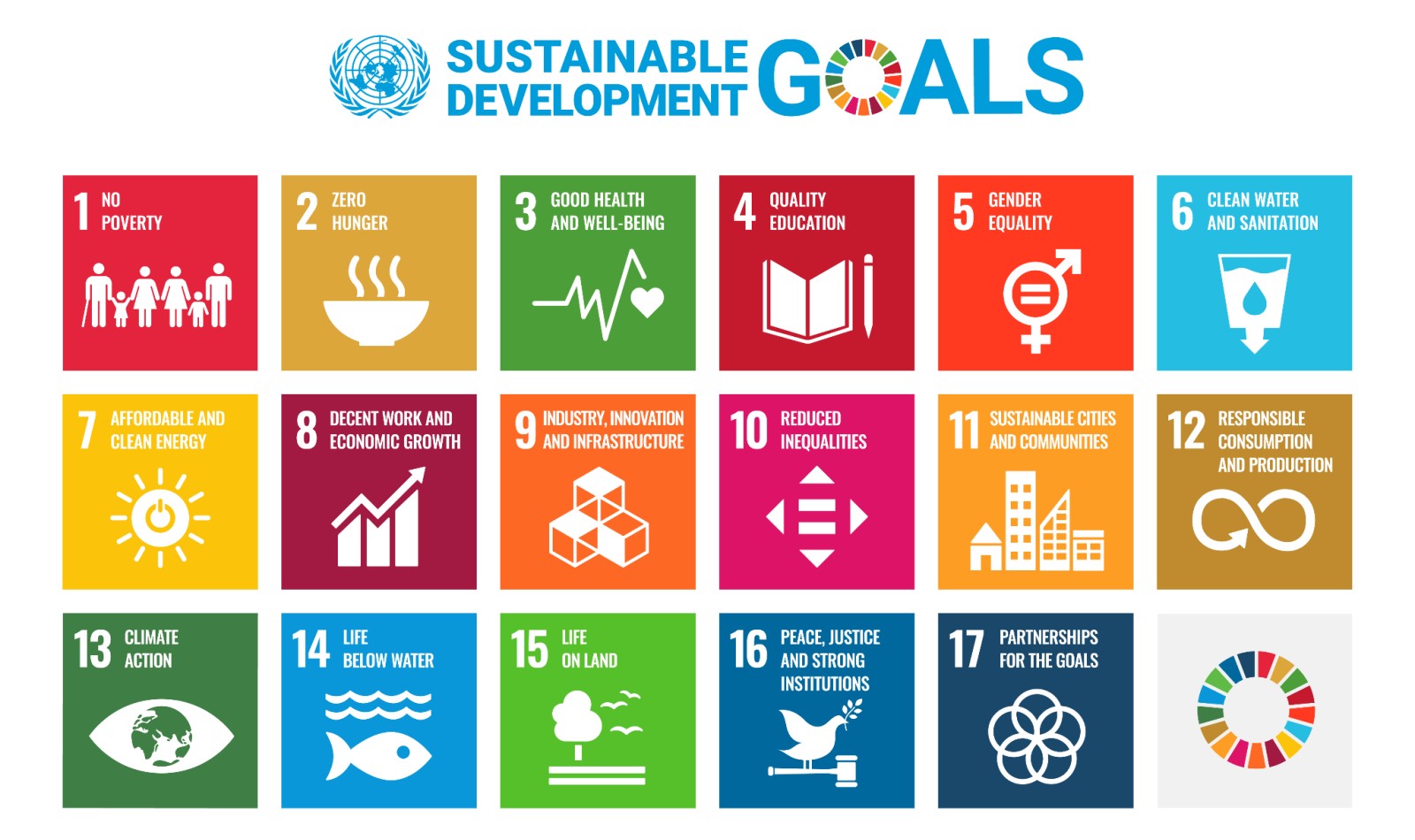
Waste management in cities is important for sustainable urban living, and is directly linked to global goals like the Sustainable Development Goals (SDGs) – especially SDG 11 (Sustainable Cities and Communities) and SDG 12 (Responsible Consumption and Production).
Proper waste management helps cities:
- Reduce environmental impact by preventing pollution and lowering greenhouse gas emissions.
- Protect public health by removing harmful materials safely.
- Preserve resources for reuse and recycling rather than extracting new raw materials.
- Support a circular economy where materials stay in productive use longer 4ETM, Recycling Bristol: Waste management: Everything you need to know about waste management, https://www.recyclingbristol.com/waste-management-everything-you-need-to-know-about-waste-management/.
As urban populations grow, cities generate increasing volumes of waste, reinforcing the need for efficient, sustainable waste systems that align with climate mitigation and other global goals. Good waste management not only keeps cities clean but also reduces environmental harm, improves public health outcomes, and supports broader sustainability targets 5UNEP, 2024.
How Waste Management Systems Work
Waste management refers to all processes involved in handling waste from “cradle to grave”. This includes collection, transport, treatment, recycling, recovery, and final disposal of materials produced through human activity. These activities apply across waste types from household and commercial to industrial and hazardous waste 6ETM, Recycling Bristol: Waste management: Everything you need to know about waste management, https://www.recyclingbristol.com/waste-management-everything-you-need-to-know-about-waste-management/.
Cities implement waste management systems to orchestrate all the steps from collection to disposal. Modern systems combine infrastructure, technology, and policy to handle urban waste efficiently and sustainably:
Collection & Transport
Waste is gathered from homes, businesses, and public spaces through scheduled pick-ups and moved to treatment or sorting facilities 7ETM, Recycling Bristol: A guide to modern waste management systems, https://www.recyclingbristol.com/a-guide-to-modern-waste-management-systems/.
Segregation
Once collected, waste is separated into categories like recyclables, organics, and hazardous materials – often using automated technologies to improve accuracy 8ETM, Recycling Bristol: A guide to modern waste management systems, https://www.recyclingbristol.com/a-guide-to-modern-waste-management-systems/.
Treatment
Treatment can involve recycling material back into production lines, composting organics, or processing waste into useful energy forms 9ETM, Recycling Bristol: A guide to modern waste management systems, https://www.recyclingbristol.com/a-guide-to-modern-waste-management-systems/.
Disposal
Only waste that cannot be reused, recycled, or recovered is sent to a landfill or, where environmentally permitted, to controlled incineration 10ETM, Recycling Bristol: A guide to modern waste management systems, https://www.recyclingbristol.com/a-guide-to-modern-waste-management-systems/.
Modern systems increasingly integrate smart technologies, from sensor-equipped bins that optimise collection routes to data platforms that track recycling performance, making waste management more efficient and transparent 11ETM, Recycling Bristol: What is a smart waste management system? Benefits & Applications, https://www.recyclingbristol.com/what-is-a-smart-waste-management-system-benefits-applications/.
Types of Waste Cities Must Manage
Urban waste comes in many forms, and each type requires different handling:
- Household waste: Everyday materials like food scraps, packaging, and textiles.
- Recyclable materials: Paper & cardboard, glass, metal, plastic and more, which can be reprocessed.
- Hazardous waste: Chemicals or materials that pose risks if not handled properly.
- Organic waste: Food and garden waste that can often be composted or biologically treated 12ETM, Recycling Bristol: Waste management: Everything you need to know about waste management, https://www.recyclingbristol.com/waste-management-everything-you-need-to-know-about-waste-management/.
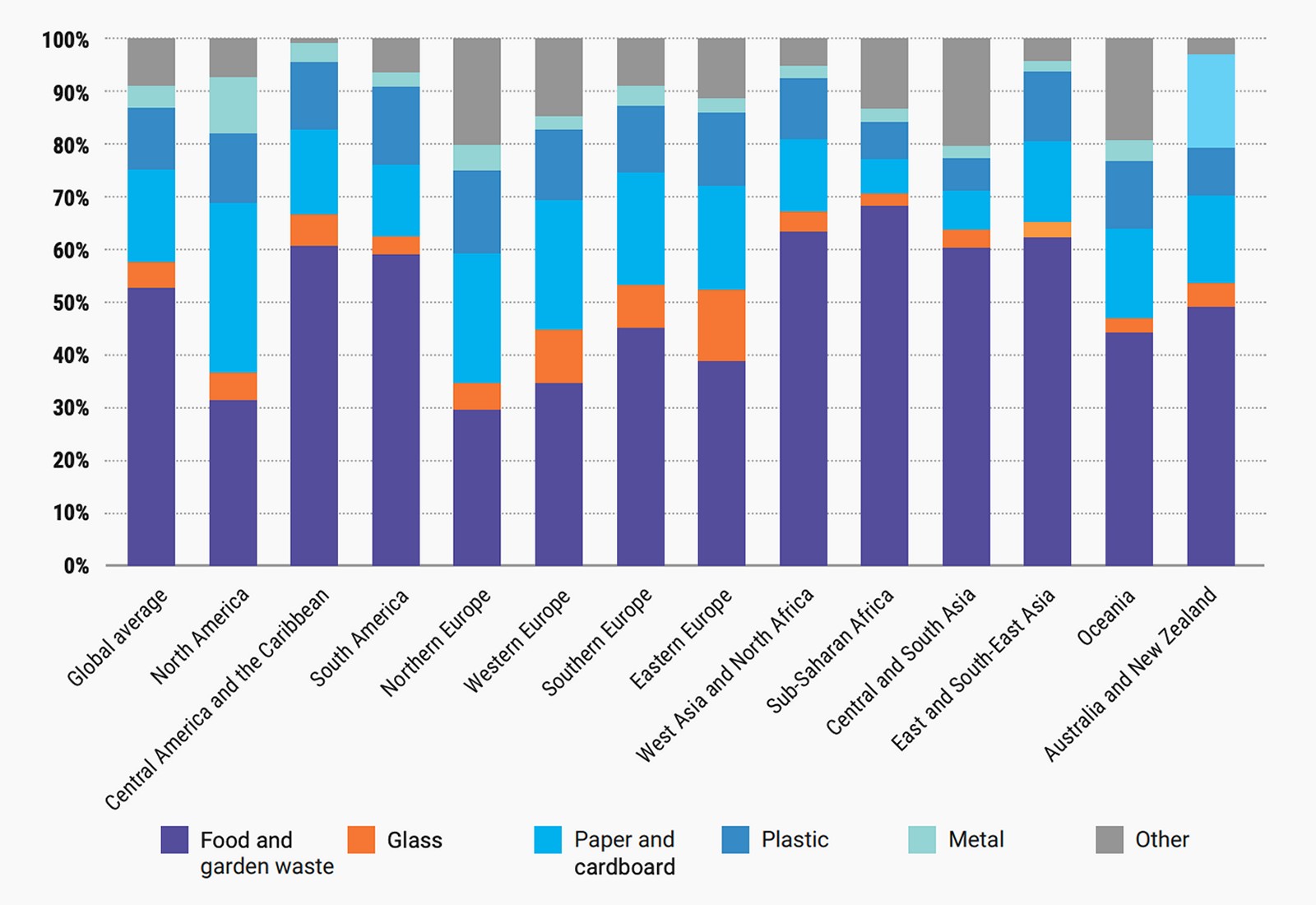
FIG. Global average and regional breakdown of municipal solid waste composition. ‘Other’ includes items such as textiles, wood, rubber, leather and household and personal hygiene products 13UNEP, 2024.
Cities must manage and recycle several main types of waste, including food and garden waste, paper and cardboard, plastics, glass, metals, and a smaller share of other materials such as textiles and hygiene products. The balance between these materials varies widely around the world, as can be seen in the graph above, depending on income levels, urbanisation, and everyday consumption habits 14UNEP, 2024.
In lower-income regions, such as Sub-Saharan Africa and South America, municipal waste is made up largely of organic waste. Shorter food supply chains mean less packaging is used, so materials like plastic and paper form a smaller share of the waste stream 15UNEP, 2024.
In higher-income and more urbanised regions, including North America and Northern and Western Europe, packaging materials account for a much larger share of waste. Longer supply chains, higher consumption, and convenience-focused lifestyles increase the use of single-use packaging and non-food products 16UNEP, 2024.
Other factors, such as climate, population density, and cultural practices, also influence the type and amount of waste cities generate, helping to explain the differences seen across regions 17UNEP, 2024.
These differences show why cities need waste management systems that are tailored to their local waste composition, enabling materials to be reused, recycled, or recovered wherever possible while minimising environmental harm 18UNEP, 2024.
The Waste Management Hierarchy
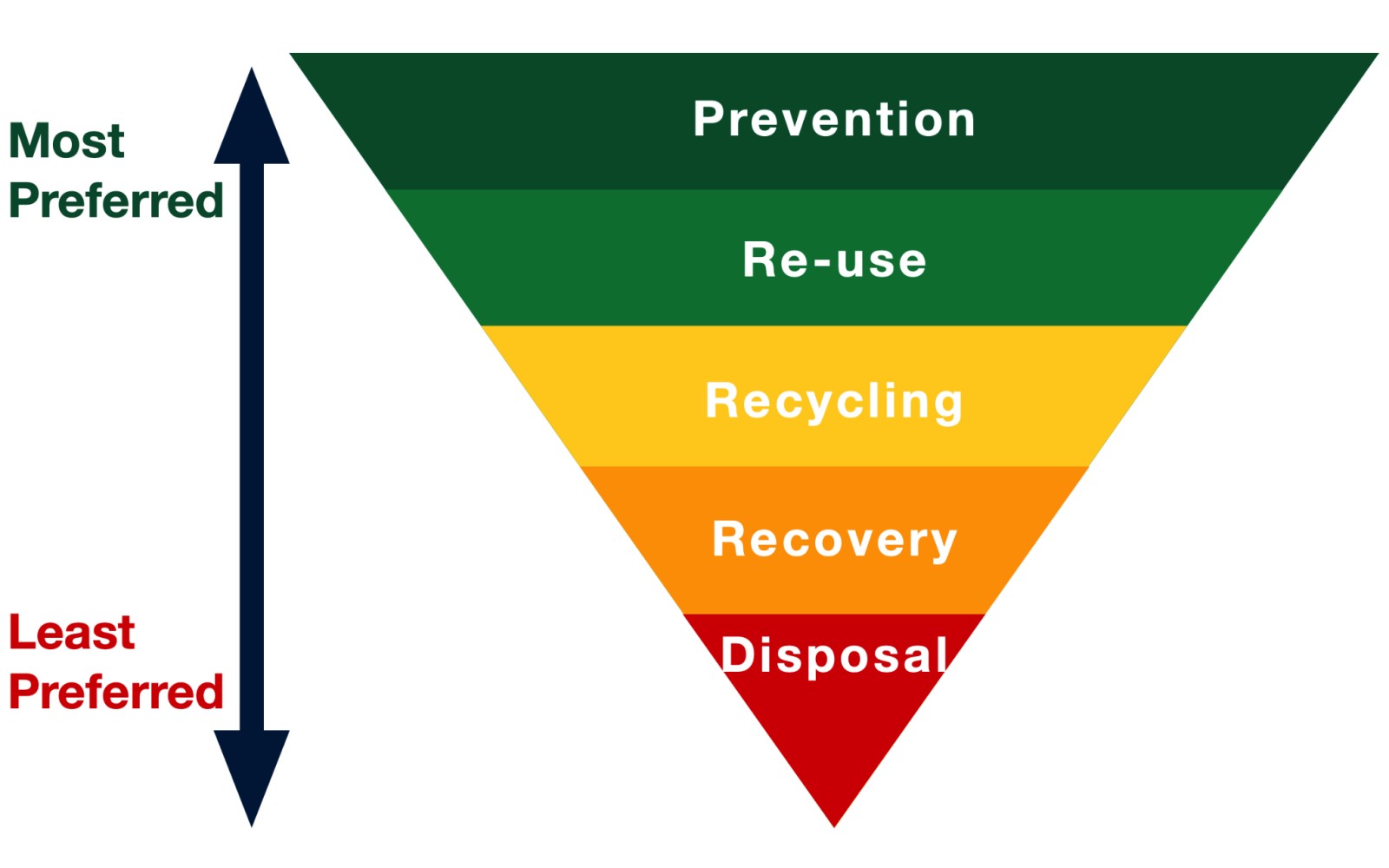
FIG. ISM Waste and Recycling
To maximise environmental benefit, the waste hierarchy ranks waste handling approaches from most to least preferred:
- Prevent: Reduce the amount of waste generated in the first place.
- Prepare for reuse: Clean, repair, or refurbish items so they can be used again.
- Recycle: Convert waste materials into new products.
- Other recovery: Extract energy or useful materials from waste not suitable for recycling.
- Dispose: The least preferred option – sending waste to landfill or incineration without recovery 19ETM, Recycling Bristol: Waste management: Everything you need to know about waste management, https://www.recyclingbristol.com/waste-management-everything-you-need-to-know-about-waste-management/.
To learn more about the Waste Management Hierarchy, explore further on the ISM, Waste and Recycling Website:
https://ismwaste.co.uk/help/what-is-the-waste-hierarchy
Learn more about Waste Management in Europe by comparing the situation in Sweden, Italy and France:
https://www.youtube.com/watch?v=14r7f9khK70
While the hierarchy guides city planners and waste managers toward solutions that keep materials in circulation and minimise environmental harm, many stakeholders can help at various stages, from governments and producers shaping prevention and reuse strategies upstream, to retailers, waste management operators, and consumers playing active roles in recycling, recovery and disposal downstream.
What Is Waste-to-Energy?
Some waste that cannot be recycled can still provide value. Waste-to-energy (WtE) describes processes that convert residual waste into usable energy forms such as heat, electricity, or biofuels, instead of sending it to a landfill. These solutions help cities maximise resource use while reducing reliance on fossil fuels 20ETM, Recycling Bristol: A guide to modern waste management systems, https://www.recyclingbristol.com/a-guide-to-modern-waste-management-systems/.
Unlike landfill disposal, waste-to-energy can reduce methane emissions from decomposing waste, an important climate advantage. However, deployment must be carefully managed to balance energy gains with environmental standards.
Learn more about the advantages and disadvantages of waste-to-energy through incineration:
https://www.youtube.com/watch?v=OPVUrO-_7SM
Case Study: Urban Waste Management in Action
Integrated Urban Systems
Cities adopting integrated waste management systems combine recycling, composting, energy recovery, and safe disposal into unified frameworks. These approaches help divert waste from landfills and make waste streams more productive for the economy 21ETM, Recycling Bristol: A guide to modern waste management systems, https://www.recyclingbristol.com/a-guide-to-modern-waste-management-systems/.
Technology-Driven Improvements
Some cities are piloting smart waste management solutions, such as IoT bins and real-time analytics, to optimise collection efficiency and increase recycling rates. This aligns with broader smart city goals of data-driven service delivery 22ETM, Recycling Bristol: What is a smart waste management system? Benefits & Applications, https://www.recyclingbristol.com/what-is-a-smart-waste-management-system-benefits-applications/.
Explore further
Learn more about waste management in Europe by comparing the situation in Sweden, Italy and France:
https://www.youtube.com/watch?v=14r7f9khK70
Learn how the city of Osaki manages to have to highest level of Waste Recycling in Japan:
https://www.youtube.com/watch?v=ymaQoEDn3uc
Learn how Taiwan fixed its Plastic pollution:
https://www.youtube.com/watch?v=-YnYwWiSiuE
Conclusion
As urbanisation intensifies, waste management will remain a cornerstone of sustainable cities. By using structured systems, prioritising the waste hierarchy, and embracing innovations like waste-to-energy and smart management networks, cities can protect the environment, improve public health, and contribute to global sustainability targets.
Bibliography
- ETM, Recycling Bristol: Waste management: Everything you need to know about waste management, https://www.recyclingbristol.com/waste-management-everything-you-need-to-know-about-waste-management/
- ETM, Recycling Bristol: A guide to modern waste management systems, https://www.recyclingbristol.com/a-guide-to-modern-waste-management-systems/
- ETM, Recycling Bristol: The beginner’s guide to waste-to-energy solutions, https://www.recyclingbristol.com/the-beginners-guide-to-waste-to-energy-solutions/
- ETM, Recycling Bristol: What is a smart waste management system? Benefits & Applications, https://www.recyclingbristol.com/what-is-a-smart-waste-management-system-benefits-applications/
- ISM Waste and Recycling Website, https://ismwaste.co.uk/help/what-is-the-waste-hierarchy
- UNEP, “Global Waste Management Outlook 2024: Beyond an Age of Waste – Turning Rubbish into a Resource”, 2024, https://wedocs.unep.org/items/36e16872-2f02-4447-a3c1-c939bf50ea92