Introduction: Why Prosumers Matter
Climate change is one of the defining challenges of our time, and addressing it requires a rapid shift away from fossil fuels such as coal, oil, and gas toward renewable sources like solar and wind. This process, known as the energy transition, represents one of the greatest transformations of the 21st century. The transition cannot be achieved by governments and big companies alone. Ordinary people, like families, schools, and neighbourhoods, can and must play a role. This is where the idea of the prosumer becomes so important.
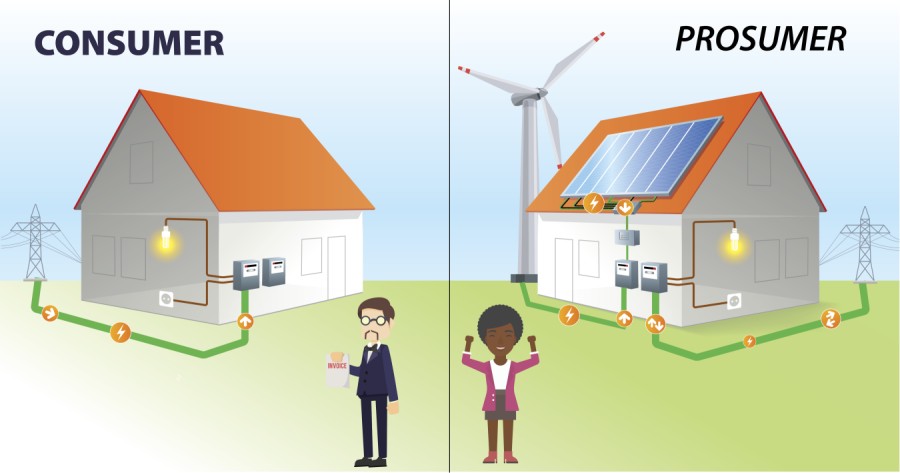
The prosumer is a central figure in the energy transition. Unlike traditional consumers who only consume electricity, prosumers both produce and consume energy, often through technologies like rooftop solar panels. This dual role transforms ordinary households, schools, and communities into active participants in shaping the energy system. Instead of relying solely on governments and large corporations, the energy transition gains strength from the bottom up, as citizens directly contribute to the shift away from fossil fuels and towards renewable sources 1U.S. Department of Energy, “Consumer vs Prosumer: What’s the Difference?”. 2017. https://www.energy.gov/eere/articles/consumer-vs-prosumer-whats-difference.
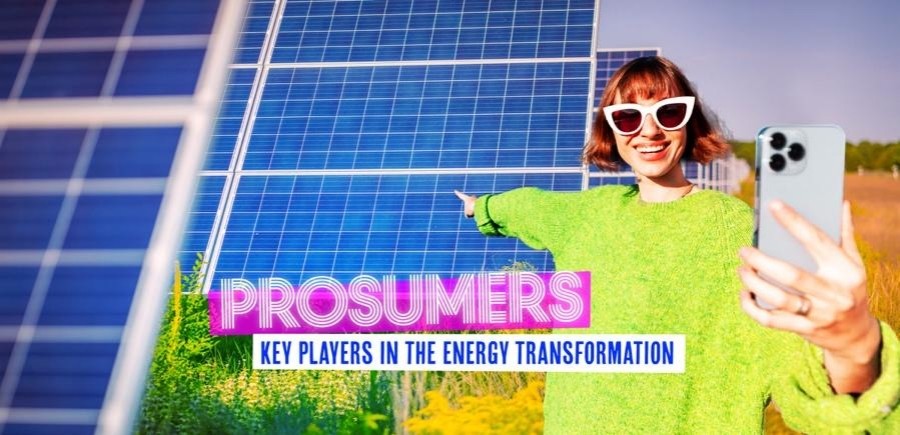
The concept of prosumers can play a significant role in advancing global climate agreements such as the UN Agenda 2030 and the Paris Agreement. By generating clean energy locally and using smart technologies to manage their consumption more efficiently, households reduce greenhouse gas emissions and ease the pressure on fossil-fuelled power plants. These small-scale contributions add up, turning ambitious international goals into visible, everyday action. As such, prosumers can help deliver on Sustainable Development Goal 7 “affordable and clean energy for all”, while also supporting urgent climate action under the Paris Agreement and Sustainable Development Goal 13 “climate action”. In this way, they help bridge the gap between global promises and local solutions, proving that climate action can begin at home 2United Nations, Department of Economic and Social Affairs, “THESDGREPORT2025”. 2025. https://sdgs.un.org/goals.
What Exactly is a Prosumer?
A prosumer 3Pieńkowski, Dariusz: “Rethinking the concept of prosuming: A critical and integrative perspective.” 2021. Energy Research & Social Science, Volume 74 is a person or household that both consumes and produces energy. For example, a family with solar panels can generate electricity during the day and use it to run their appliances. If they produce more than they need, they can feed the surplus into the electricity grid so that others can benefit. If they have a battery or even an electric car, they can store the energy for later, using it in the evening or during cloudy weather.
To make this system work effectively, households need smart meters. A smart meter is a digital electricity meter that measures energy use in real time and communicates it both to the household and to the grid operator. Unlike traditional meters, which only provide a monthly or yearly reading, smart meters show exactly how much electricity is being used at any moment. For families, this means they can see when their energy use is highest and adjust their habits to save money. For the wider energy system, it means that electricity supply and demand can be balanced more intelligently.
But smart meters alone are not enough. They need to be paired with intelligent energy management systems. These are digital systems that automatically control when appliances, heating, or even car charging take place. For example, an intelligent energy management system can tell your dishwasher to run when solar panels are producing lots of power or when electricity prices are low. It can also store surplus energy in a battery for later use. By coordinating all of this automatically, households become active participants in the energy transition without having to think about every decision4Enel, “Prosumers: when energy consumers become energy producers”. 2023. https://www.enelgreenpower.com/learning-hub/gigawhat/search-articles/articles/2023/03/prosumers-energy.
What Needs to Happen for Prosumers to Thrive?
For prosumers to become widespread, several conditions need to be met 5Federal Ministry for Economic Affairs and Energy, “Smart Meter: the key to a smarter energy future”. 2025..
- First, households require access to the right technologies: solar panels, heat pumps, smart meters, energy storage systems, and modern electrical infrastructure.
- Second, they need financial support and clear incentives. Renewable technologies often require significant investment at the beginning, and while they save money in the long run, many families need help to take the first step. Governments can provide subsidies, or energy companies can offer flexible tariffs that reward households for using or producing energy at the right times.
- Equally important is knowledge and trust. People must understand how prosumer systems work, and they must feel secure that their data is protected. Smart meters, for example, collect detailed information about household energy use, which raises concerns about privacy. Without strong data protection and transparent communication, many people remain sceptical.
The Challenges We Face in the Real World
Despite the promise of the prosumer model, progress has been uneven. For example, in Germany, a country often seen as a leader in renewable energy, less than two per cent of households currently have smart meters installed. Furthermore, the upfront costs of installing solar panels, batteries, or smart energy systems remain high for many families. Infrastructure also lags behind: electricity grids in many countries were built for one-way energy flows, from big power plants to households, and are not yet fully adapted to the two-way flows created by millions of small producers.
Social and behavioural challenges add another layer. Becoming a prosumer requires households to think differently about how and when they use electricity. For instance, running the washing machine when the sun is shining or electricity prices are low may seem like a small change, but it requires new habits and awareness. These behavioural shifts can be harder to achieve than the technology itself.
Germany: A Case Study in Progress and Obstacles
Germany offers an excellent example of both the opportunities and difficulties of integrating high volumes of renewable energy into the grid. The country has invested heavily in wind and solar power, and renewable energy now makes up a large share of its electricity production. Yet integrating households into the energy system remains a challenge.
One challenge of renewable energy is its variability. At times of high wind or solar generation, electricity supply can exceed immediate demand, leading to the curtailment of renewable power, while at other times fossil-fuelled plants are kept online to cover peak demand when renewable output is low. These problems are not caused by supply alone, but also by inflexible consumption patterns. To address this, Germany is promoting smart meters and intelligent energy management systems that allow households to shift part of their energy use to periods of high renewable availability, reduce peak demand, and store excess electricity locally. In this way, households can support grid stability and reduce reliance on fossil backup capacity 6Federal Ministry for Economic Affairs and Energy, “Smart Meter: the key to a smarter energy future”. 2025.
In addition to demand-side flexibility, the prosumer model offers another way for households to support renewable energy integration. By producing electricity locally through rooftop solar panels and consuming it directly or storing it for later use, prosumers reduce the amount of electricity that must be produced and transported through the grid during peak periods. This lowers overall system stress, decreases the need for fossil-fuelled backup power, and helps ensure that renewable energy is used where and when it is generated, rather than being curtailed.
Other solutions that are evolving and may help solve some of the challenges include:
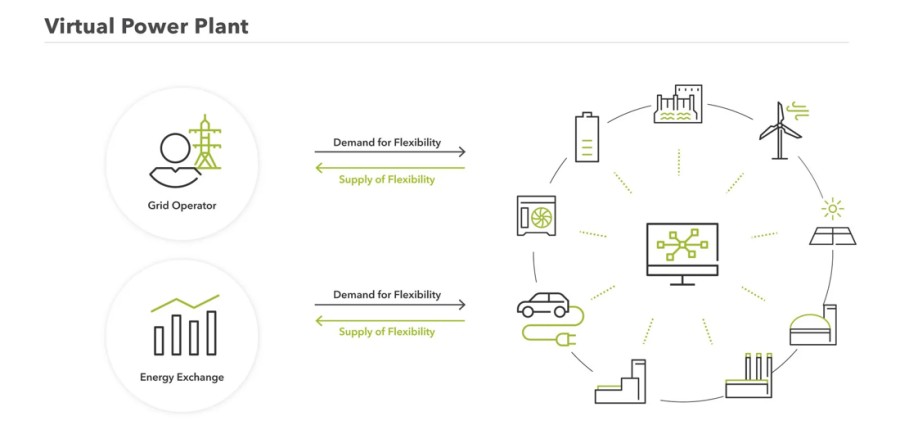
- Virtual power plants (VPPs): is a digital platform that connects many small, decentralised energy resources (like rooftop solar panels, home batteries, wind turbines, electric vehicles). The idea is to aggregate these decentralised resources and by using advanced technical coordination and market participation, make them behave like a single player in the energy system 7Next Kraftwerke, “Virtual Power Plant. How to Network Distributed Energy Resources”. No Date. https://www.next-kraftwerke.com/vpp/virtual-power-plant.
- Energy communities (ECs): is a group of citizens, households, local authorities, or small businesses who come together to produce, share, and sometimes sell renewable energy. The main goals of ECs are local empowerment, affordability, and sustainability, often with community values at the core 8European Commission, “Energy communities”. No Date. https://energy.ec.europa.eu/topics/markets-and-consumers/energy-consumers-and-prosumers/energy-communities_en 9Óscar Güell Elías, “The social impact of energy communities: ten benefits they bring”. 2023. https://gr.boell.org/en/2023/06/07/o-koinonikos-antiktypos-ton-energeiakon-koinotiton-deka-apo-ta-ofeli-toys.
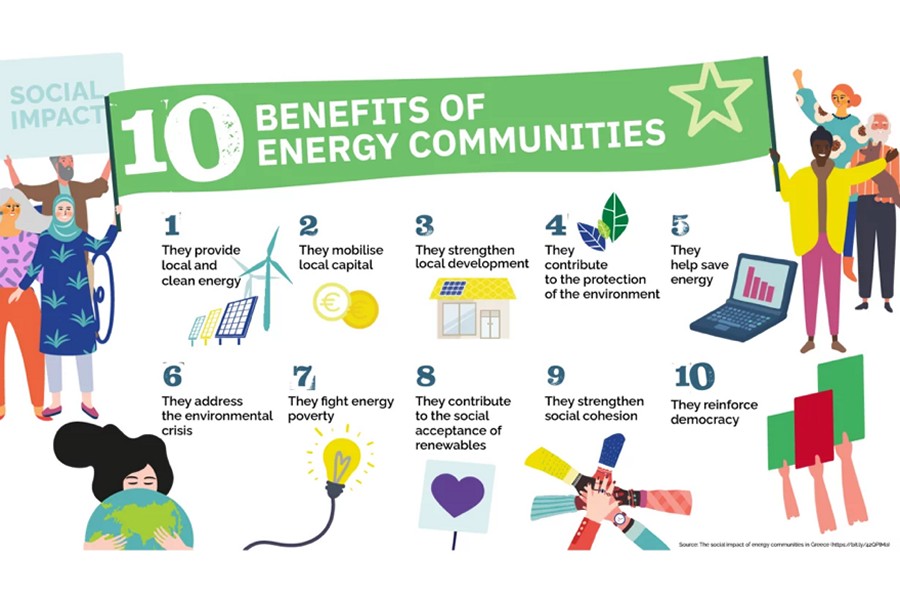
These efforts show that while the road is not easy, the prosumer model is evolving into new forms such as Virtual Power Plants and Energy Communities, each with different market structures and social objectives. Both approaches build on the idea that citizens are not just passive consumers but active participants in the energy system. By equipping people with the tools to produce, share, and intelligently manage their own energy, these models turn individual action into collective power. Whether through digital aggregation in VPPs or local cooperation in Energy Communities, this bottom-up approach makes the energy transition faster, more affordable, and more resilient.
Learn more about how Energy Communities operate 10https://audiovisual.ec.europa.eu/media/video/I-275605:
Learn more about how Germany’s Feldheim went from an agricultural village to a clean energy role model – with its own renewable electricity grid and heating network. Here’s how it brought locals on board 11https://www.youtube.com/watch?v=NW_ThUR7Wus:
Conclusion — From Global Goals to Local Action
The concept of the prosumer demonstrates how the energy transition is not just a political or technical issue but also a social one. By empowering households to generate, store, and manage their own renewable energy, prosumers make climate action practical and personal. They connect the global ambitions of the Paris Agreement and Agenda 2030 to the daily lives of ordinary people.
The journey is not without obstacles, ranging from the cost of technology to the need for new habits and better infrastructure. Yet, as Germany’s example shows, prosumers are already helping shape a cleaner, fairer, and more resilient energy system. For today’s students, the lesson is clear: the energy transition is not only something happening in distant political negotiations, but something you and your communities can take part in directly. By becoming prosumers, you are not just using energy; you are helping to shape the future.
Bibliography
- Enel, “Prosumers: when energy consumers become energy producers”. 2023. https://www.enelgreenpower.com/learning-hub/gigawhat/search-articles/articles/2023/03/prosumers-energy
- European Commission, “Energy communities”. No Date. https://energy.ec.europa.eu/topics/markets-and-consumers/energy-consumers-and-prosumers/energy-communities_en
- Federal Ministry for Economic Affairs and Energy, “Smart Meter: the key to a smarter energy future”. 2025. https://www.bundeswirtschaftsministerium.de/Redaktion/EN/Textsammlungen/Energy/smart-meters.html
- Next Kraftwerke, “Virtual Power Plant. How to Network Distributed Energy Resources”. No Date. https://www.next-kraftwerke.com/vpp/virtual-power-plant
- Óscar Güell Elías, “The social impact of energy communities: ten benefits they bring”. 2023. https://gr.boell.org/en/2023/06/07/o-koinonikos-antiktypos-ton-energeiakon-koinotiton-deka-apo-ta-ofeli-toys
- Pieńkowski, Dariusz: “Rethinking the concept of prosuming: A critical and integrative perspective.” Energy Research & Social Science, Volume 74
- United Nations, Department of Economic and Social Affairs, “THESDGREPORT2025”. https://sdgs.un.org/goals
- S. Department of Energy, “Consumer vs Prosumer: What’s the Difference?”. 2017. https://www.energy.gov/eere/articles/consumer-vs-prosumer-whats-difference