
Museums as a Public Space
When we imagine the smart cities of the future, we often think about new technologies, sustainable buildings and intelligent transport systems. But a truly smart city is also one where people feel connected to their surroundings, their history and each other. Museums and cultural spaces can play an important role in making our cities more inclusive, vibrant and welcoming. By bringing culture into everyday public spaces and giving citizens the opportunity to participate, share their stories and shape their city’s identity, we can help build cities where everyone feels they belong. After all, a smart city is not just about how a city functions, but also about how people experience living in it.
Equity in Cultural Accessibility
While a city might offer “equal” access by keeping museum doors open to everyone, true equity means meeting people where they are. Physical barriers like grand stone steps or heavy doors, alongside psychological barriers, often make marginalised or lower-income groups feel that museums are “not for them”.
By treating the museum as an open public space, urban planners achieve equity by:
- Removing Physical Obstructions: Designing “Satellite Exhibits” and “Micro-Museums” at ground level in everyday locations, making culture completely accessible to those with mobility issues or the elderly.
- Fostering Social Cohesion: Utilising shared outdoor spaces—like community gardens or pedestrian streets—where diverse groups can reconnect, share responsibility for their community, and build social bonds.
- Bridging the Age Gap: Transforming spaces into “child-friendly” and youth-centric environments that encourage active participation, creation, and socialisation over strict “look but don’t touch” rules.
What is a “Museum Without Walls”?
A truly smart and inclusive city looks beyond its digital infrastructure to rethink its physical spaces. Traditionally, museums have been viewed as “silent boxes”—imposing, indoor institutions where citizens are expected to practice quiet observation.
However, when we view a museum through the lens of modern urban planning, it transforms from a static building into a dynamic public space. When cultural institutions “break their walls,” they stop being intimidating destinations and instead become an active part of the city’s social fabric, taking art, history, and community storytelling directly out into parks, plazas, and transit hubs1American Alliance of Museums, “Serving Broader Audiences, Museums Engage Communities with Public Space,” American Alliance of Museums (blog), January 27, 2020, https://www.aam-us.org/2020/01/27/serving-broader-audiences-museums-engage-communities-with-public-space/.
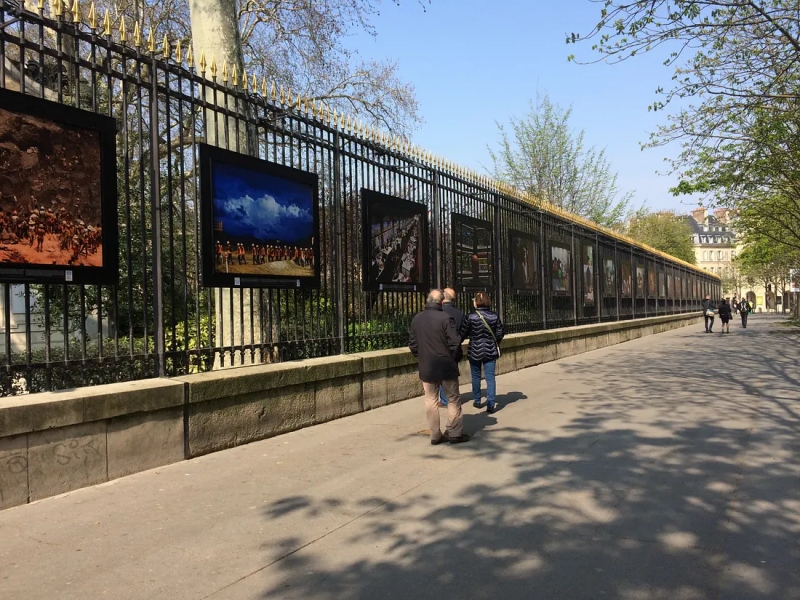
Êtres au Travail (Being At Work), Magnum Photography Exhibition, Jardin du Luxembourg, Paris, France, 2019. Photo by Alison Spence Montillet2Alison Spence Montillet, “Taking It to the Streets: Photography Exhibitions in Public Spaces,” Medium, https://medium.com/@alisonspencemontillet/taking-it-to-the-streets-photography-exhibitions-in-public-spaces-6cec46435d00.
The Role of Technology and Digital Connection
Smart cities leverage data and digital tools to enhance how residents interact with these distributed cultural spaces. Technology acts as a vital bridge to create deeper engagement without crowding physical environments.
- Interactive Mobile Tools: Passers-by can use their smartphones to scan open-source interfaces or utilise tools like screen readers to “deep dive” into the history of a local park or plaza.
- Augmented Reality (AR): Using AR overlays or gamification allows pedestrians to “unlock” hidden historical stories or digital art installations directly on the street.
- Participatory Governance: Digital platforms allow citizens to directly propose ideas, vote on what local histories are highlighted in their neighborhoods, and co-curate public exhibitions.
Real-World Challenges & Frameworks
Moving cultural spaces outdoors introduces distinct urban challenges that planners must account for:
- The Durability vs. Accessibility Balance: Outdoor installations must be meticulously designed to survive the elements (rain, sun, wind) and resist potential vandalism, all while remaining safe, welcoming, and accessible to individuals of all ages, abilities, and language backgrounds.
- Use of public spaces vs. their original use: While it is great to put installations in public spaces such as parks and squares, these spaces already serve diverse functions for the local population. Not everyone may welcome an installation in the space they usually play, meet, gather or walk around. Careful consideration of the community’s needs must be taken into consideration when taking on these initiatives.
Even if challenging, following the mandate of the UN’s Sustainable Development Goal 11 (SDG 11), local governments are encouraged to adopt a holistic approach3United Nations, “Goal 11: Make Cities and Human Settlements Inclusive, Safe, Resilient and Sustainable,” Sustainable Development Goals, accessed August 31, 2026, https://sdgs.un.org/goals/goal11. True smart city innovation ensures that green spaces and public services are distributed equitably across the urban layout, utilizing technology not just for efficiency, but as a powerful means to make community cultural hubs inclusive, safe, resilient, and sustainable for everyone.
Real-World Case Study: Copenhagen’s “Museum Wall” (Væg-galleriet)
To see the “Museum Without Walls” framework in action, look no further than the city of Copenhagen, Denmark, and the Museum of Copenhagen’s Digital Wall (Væggen).
When the museum was undergoing major transitions and physical relocations, they shifted culture directly into the public domain by building a massive, mobile, outdoor digital installation. Placed in busy public squares and transit paths, this multi-touch screen wall allowed daily commuters, youth, and passersby to interact with 3D historical archives, upload their own contemporary photos of the city, and share community narratives.
By turning a city sidewalk into a democratic, collaborative gallery, Copenhagen successfully bypassed physical and financial museum barriers. This initiative catalyzed cultural participation among demographics that rarely stepped inside traditional “silent boxes,” setting a gold standard for smart city placemaking4Gibson International. “The MAS (Museum aan de Stroom) & The Copenhagen Museum Wall Initiatives: Redefining Cultural Participation and Digital Placemaking in the Modern City.” Portfolio case study. Accessed August 31, 2026. https://www.gibsoninternational.design/portfolio/vaeggen-touch-wall/.
To learn more about this initiative, watch this video:
Inclusion
Another aspect of museums as public spaces is related to making the actual museums more accessible and inviting to everyone5Ana Isabel González-Herrera, Andrea Betsabé Díaz-Herrera, Paula Hernández-Dionis, and David Pérez-Jorge, “Educational and Accessible Museums and Cultural Spaces,” Humanities and Social Sciences Communications 10, no. 1 (2023): 67, https://pmc.ncbi.nlm.nih.gov/articles/PMC9943025/. As mentioned previously, one challenge can be related to this idea that museums are often perceived as formal or static environments, which can alienate younger generations. To counter this, many institutions are actively reshaping their approach to engage youth by incorporating interactive technologies, participatory exhibits, and youth-led programming that encourages creative self-expression. Engaging young people is crucial for the future of museums, as it fosters long-term cultural appreciation, ensures demographic relevance, and builds a new generation of visitors and advocates. However, museums face significant challenges in achieving this, including competing with fast-paced digital media, overcoming perceptions of elitism, and adapting traditional curatorial models to feel relevant, authentic, and inclusive to contemporary youth culture.
Case Study: Talking Teens
Talking Teens in Parma, Italy, is a great example that brings together accessibility, inclusion, technology and the younger generations. The project is aimed at enhancing the city’s monumental heritage by actively involving teenagers and leveraging the potential of new technologies to offer innovative cultural experiences accessible to everyone.
Currently, sixteen statues in Parma can “talk” via phone call, QR code, a dedicated app, or a traditional call, offering three-minute narratives available in Italian, English, sometimes in the Parmigiano dialect, and even through LIS (Italian Sign Language) video calls.
Starting in 2027, five new subjects will join the project: the statue of Nicolò Paganini, the painting “Fior di Loto” (Lotus Flower) by Amedeo Bocchi at the Pinacoteca Stuard, the Parco Ducale featuring Maria Luigia, the birthplace of Arturo Toscanini, and the Monastery of San Paolo with Abbess Giovanna da Piacenza, all of which will tell their stories using the same digital tools.
The route is fully accessible, featuring Braille plaques and remaining usable for individuals with motor and sensory disabilities. The free app, available at www.talkingteens.it, offers interactive maps, guided itineraries, quizzes, and in-depth information. The voices of the statues and new subjects are performed by professional actors and local students, creating an intergenerational dialogue between young people and the community6Comune di Parma, “Talking Teens – Le Statue Parlano!” news release, February 12, 2026, https://cultura.comune.parma.it/news/2026-02-12/it-IT/Talking-Teens-Le-Statue-Parlano-1.aspx.
This project is a great example of inclusive, accessible public spaces!
Check out this video in Italian about the project:
Decolonization of European Museums
As European cities transition toward more inclusive urban futures, transforming museums into democratic public spaces requires addressing their historical roots. Many of Europe’s major cultural institutions were founded during eras of imperial expansion, resulting in collections deeply tied to colonial exploitation. Decolonizing these spaces goes beyond merely changing exhibit captions; it involves a fundamental restructuring of ownership, narrative control, and physical space to foster genuine equity and healing within diverse urban communities7Felwine Sarr and Bénédicte Savoy, The Restitution of African Cultural Heritage: Toward a New Relational Ethics, report submitted to the President of the French Republic (Paris: Ministry of Culture, 2018).
In practice, European cities and institutions are approaching decolonization through several key mechanisms:
- Restitution and Provenance Research: Transparently investigating the origins of artifacts and actively returning plundered heritage to their countries of origin, such as Germany’s return of Benin Bronzes to Nigeria8Dan Hicks, The Brutish Museums: The Benin Bronzes, Colonial Violence and Cultural Restitution (London: Pluto Press, 2020).
- Co-Curating and Shared Authority: Moving away from a singular, Eurocentric curatorial voice by inviting indigenous communities and diaspora groups to actively design exhibitions and narrate their own histories.
- Decentralising the Narrative: Utilising digital tools and public spaces outside the physical museum to contextualise controversial monuments and colonial artefacts, allowing citizens to critically engage with history in their everyday urban environments.
Ultimately, rethinking museums as fluid, public spaces is not just an exercise in urban design—it is a fundamental commitment to democratic and equitable cities. By tearing down the physical, social, and colonial walls of the traditional “silent box,” smart cities can transform cultural heritage from an intimidating, static destination into a living asset woven directly into the everyday fabric of the streets. Through the strategic use of open-air initiatives, digital touchpoints, and participatory co-creation, the modern city shifts its residents from passive observers to active authors of their shared urban narrative. In doing so, municipal planners achieve the true promise of sustainable development: creating inclusive, resilient spaces where every citizen, regardless of background, enjoys equal ownership over the community’s collective culture.
Bibliography
- American Alliance of Museums. “Serving Broader Audiences, Museums Engage Communities with Public Space.” American Alliance of Museums (blog). January 27, 2020. https://www.aam-us.org/2020/01/27/serving-broader-audiences-museums-engage-communities-with-public-space/.
- Gibson International. “The MAS (Museum aan de Stroom) & The Copenhagen Museum Wall Initiatives: Redefining Cultural Participation and Digital Placemaking in the Modern City.” Portfolio case study. Accessed August 31, 2026. https://www.gibsoninternational.design/portfolio/vaeggen-touch-wall/.
- González-Herrera, Ana Isabel, Andrea Betsabé Díaz-Herrera, Paula Hernández-Dionis, and David Pérez-Jorge. “Educational and Accessible Museums and Cultural Spaces.” Humanities and Social Sciences Communications 10, no. 1 (2023): 67. https://pmc.ncbi.nlm.nih.gov/articles/PMC9943025/.
- Hicks, Dan. The Brutish Museums: The Benin Bronzes, Colonial Violence and Cultural Restitution. London: Pluto Press, 2020.
- Maffei, Tiziana. “Accessibility in the Museums: Guidelines of the Ministry of Cultural Heritage.” ICOM Italia. July 2019. https://www.icom-italia.org/wp-content/uploads/2019/07/TizianaMAFFEI.pdf.
- Montillet, Alison Spence. “Taking It to the Streets: Photography Exhibitions in Public Spaces.” Medium. https://medium.com/@alisonspencemontillet/taking-it-to-the-streets-photography-exhibitions-in-public-spaces-6cec46435d00.
- Sarr, Felwine, and Bénédicte Savoy. The Restitution of African Cultural Heritage: Toward a New Relational Ethics. Report submitted to the President of the French Republic. Paris: Ministry of Culture, 2018.
- United Nations. “Goal 11: Make Cities and Human Settlements Inclusive, Safe, Resilient and Sustainable.” Sustainable Development Goals. Accessed August 31, 2026. https://sdgs.un.org/goals/goal11.