

Public Safety: Building Secure Urban Futures
Cities are growing fast and are becoming increasingly complex. Public safety in cities means protecting citizens from harm – including crime, accidents, natural disasters, and cyberattacks – through coordinated efforts. In smart cities, digital tools like surveillance systems, real-time data tracking, early warning systems and digital communication can help improve both physical and online security, while also promoting trust, accessibility, and inclusion for all citizens1World Bank, “Smart cities for all: Inclusive approaches to urban digital transformation.” 2021, World Bank Group, https://www.worldbank.org/en/topic/digitaldevelopment/brief/smart-cities.
Public safety is deeply intertwined with global initiatives and agreements. For example, the United Nations’ Agenda 2030 for Sustainable Development: SDG 11: Sustainable Cities and Communities focuses on making cities safe, resilient, and inclusive. Targets in this goal include access to safe, affordable, accessible, and sustainable transport systems for all, reducing disaster deaths, and improving perceived safety in public spaces. These objectives aim to protect people from everyday risks, like crime or traffic accidents, as well as major threats such as natural disasters, while ensuring that all citizens have equal access to services and opportunities2The Global Goals, ”Goal 11: Sustainable cities and communities – The Global Goals”, no date, https://www.globalgoals.org/goals/11-sustainable-cities-and-communities/.
Check out this video to see how Paris is handling security:
What does safety mean?
Exploring Maslow’s hierarchy of needs theory is relevant when studying public safety in smart cities because it highlights that safety is a basic human need and a precondition for achieving other higher goals, such as education, community belonging, and personal growth. While Maslow’s theory suggests that human motivation is driven by a series of hierarchical needs, implying a progression from basic to more complex needs, Maslow himself emphasised that these needs are not strictly linear and can be pursued simultaneously or in a different order based on individual circumstances3Saul McLeod, “Maslow’s hierarchy of needs.” 2018, SimplyPsychology, https://www.simplypsychology.org/maslow.html. For example, a student might be working on friendships (a “belonging” need) while also making sure they feel safe at home and school (a “safety” need). The levels are connected, and progress at one level often supports growth at others.
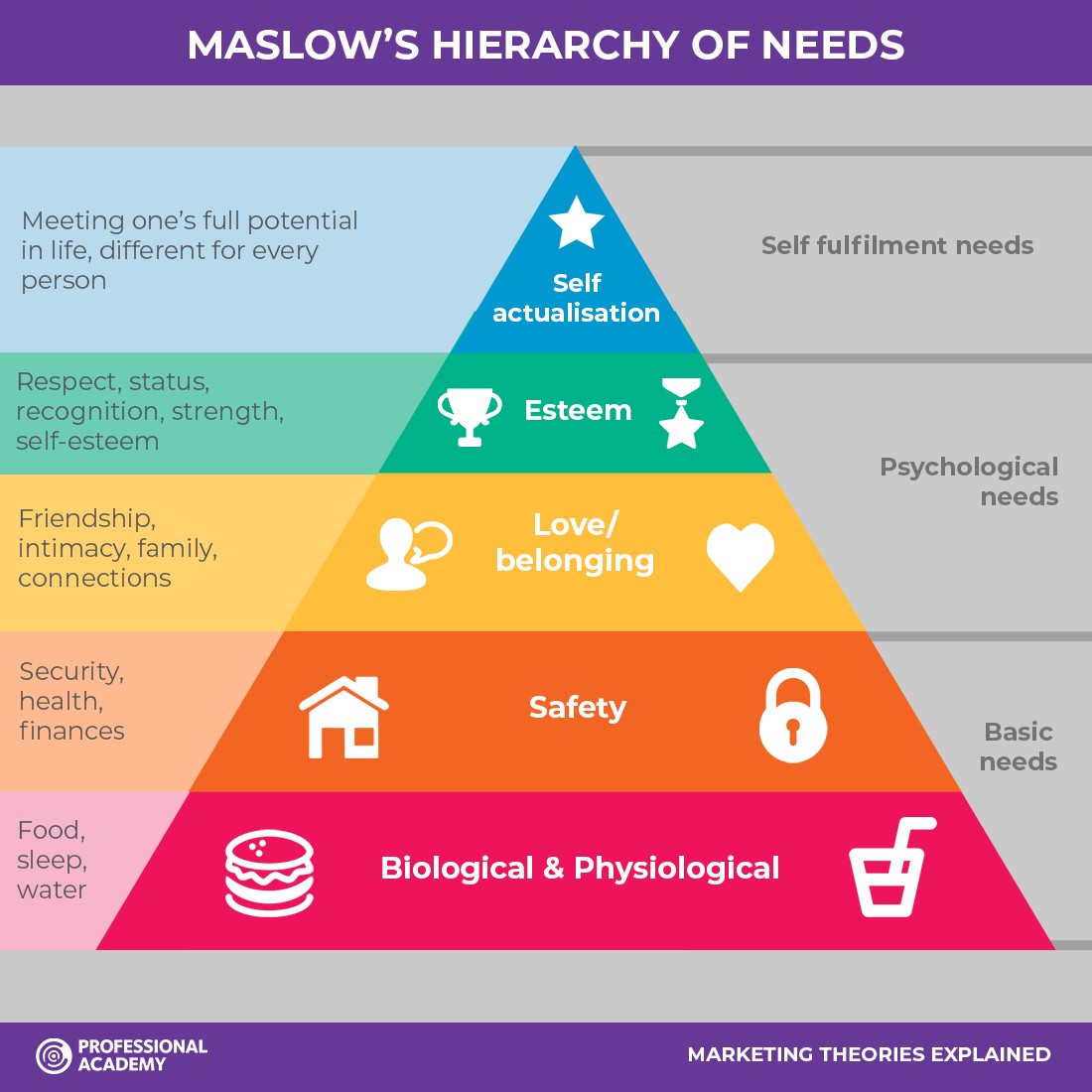
FIG. 1: Maslow’s hierarchy of needs4Professional Academy, “Marketing Theories – Maslow’s Hierarchy of Needs,” 2025, https://www.professionalacademy.com/blogs/marketing-theories-maslows-hierarchy-of-needs
Interested in understanding Maslow’s theory a little better? https://www.youtube.com/watch?v=L0PKWTta7lU&t=111s
Smart technologies can help authorities create cities that allow people to feel safer. For instance, if a neighbourhood has high crime rates, young people might feel anxious walking to school, making it harder to concentrate on learning or building friendships. Similarly, in the online world, if a system is not secure and personal data can be stolen, people may lose trust and avoid using useful digital services. This is why smart cities put so much effort into technologies like better street lighting, surveillance cameras, and flood warning systems5Smart City Strategies & Solutions, “Enhancing Public Safety and Security with Smart City Technologies.” 2025, https://www.smartcityss.com/resources/enhancing-publ,,ic-safety-and-security-with-smart-city-technologies. These not only prevent harm but also give people confidence that they can live, learn, and grow in their communities without constant fear.
Types of Threats in Smart Cities
Crime and Social Unrest
Crime in cities can include things like theft, assault, vandalism, drug trafficking, and organised crime. Increasing population density and social inequality, which many cities are experiencing, can contribute to higher crime rates. Furthermore, expressions of frustration and grievances can sometimes lead to social unrest, which poses another challenge to urban safety.
Accidents
In cities, accidents can happen in lots of ways, like car crashes, injuries on construction sites, problems at factories, or issues with buses and trains. As cities get bigger, there’s more traffic and operations become more complicated to manage, which can lead to more accidents if we’re not careful6BBC Future, “How data is helping governments build better cities,” 2015, https://www.bbc.com/future/bespoke/specials/connected-world/government.html.
Natural Disasters
Cities are increasingly vulnerable to earthquakes, floods, wildfires, and extreme weather events, which are becoming more frequent due to climate change. Effective urban planning that ensures the city adequately adapts to such threats – by reinforcing key infrastructure providing essential services, such as roads, water and energy systems, and installing early warning systems – is crucial to mitigating their impact.
Cyberattacks
Smart cities rely heavily on digital infrastructure for energy grids, transport systems, and communications. This makes them targets for hackers, who can disrupt services, steal personal data, or compromise emergency response systems7Elvira Ismagilova et al, “Security, Privacy and Risks Within Smart Cities: Literature Review and Development of a Smart City Interaction Framework”, 2020, Information Systems Frontiers, pp.393–414. doi: https://doi.org/10.1007/s10796-020-10044-1.
Public Health Emergencies
Cities must be ready to respond swiftly and effectively to health crises, such as pandemics or disease outbreaks. These emergencies demand coordinated action across public health services, emergency responders, local governments, and communication systems. Key measures include surveillance systems for early detection, clear communication strategies to inform the public, and well-prepared healthcare facilities with adequate resources. Urban density and global connectivity increase the speed at which diseases can spread, making proactive planning essential to reduce transmission and protect vulnerable populations.
A coordinated strategy is needed to respond to threats
Building safe, resilient, and responsive urban environments requires a coordinated strategy that facilitates adequate policing, community oversight, digitalisation and resilient infrastructure to ensure safety in both physical and digital environments8Jozsef Papp, “How safe is your smart city?”, 2022, Interdisciplinary Description of Complex Systems, pp.57–63. doi: https://doi.org/10.7906/indecs.20.1.8. Such an approach must strive to ensure that different sectors, including emergency services, law enforcement, urban infrastructure, and community initiatives, complement each other while being supported by real-time data and innovative technologies. Innovative technology can support such services to provide increased urban safety when used wisely.
Let’s explore each element a little closer:
Policing
Policing in a smart city involves both governance structures and law enforcement practices. Governance ensures that safety technologies, such as surveillance cameras, predictive crime mapping, and certain AI tools, are used in ways that respect privacy, uphold civil rights, and maintain transparency9European Parliament and Council, “Regulation (EU) 2016/679: General Data Protection Regulation (GDPR)”, 2016, https://gdpr-info.eu/. Within the EU, strict rules apply to the use of technologies such as facial recognition, which is only permitted under limited and regulated circumstances10European Commission, “EU Artificial Intelligence Act,” 2024, https://artificialintelligenceact.eu/article/5/. Effective governance also ensures inter-agency coordination and public accountability, essential to building trust11Naomi Jacobs et al, “Who Trusts in the Smart City? Transparency, Governance, and the Internet of Things.” Data & Policy 2, 2020, https://doi.org/10.1017/dap.2020.11. On the operational side, smart policing can make use of artificial intelligence (AI), real-time communication systems, and data-sharing platforms to improve public safety. When applied responsibly and in compliance with EU law, these technologies allow police departments to allocate resources more efficiently, respond to incidents more quickly, and design proactive strategies based on reliable, data-driven insights12European Parliament and Council, 2016.
Challenges and Risks
Despite these benefits, smart policing raises significant concerns. Predictive policing tools and AI-driven systems may reproduce and even amplify existing racial and social biases, leading to disproportionate targeting of marginalised communities13NAACP, “Artificial Intelligence in Predictive Policing Issue Brief,” no date, https://naacp.org/resources/artificial-intelligence-predictive-policing-issue-brief#:~:text=Jurisdictions%20who%20use%20this%20tool,Challenges. Similarly, facial recognition technologies have been shown to produce higher error rates for women and people of colour, reinforcing risks of wrongful identification and automated discrimination14European Commission, 2024. In the EU context, such risks are recognised, which is why the EU AI Act places restrictions on high-risk systems and prohibits certain uses outright. Without strong oversight, these systems can contribute to a “surveillance state,” where constant monitoring undermines privacy and civil liberties. To address these challenges, governance must establish clear rules, provide robust oversight, and actively work to eliminate bias, ensuring that technology strengthens public safety without eroding public trust.
Community Oversight, Citizen Participation, and Neighbourhood Watch
Community oversight, civic engagement, and neighbourhood watch programs show how important ordinary citizens can be in keeping cities safe and accountable. Oversight allows residents to monitor public services, influence local decisions, and make sure institutions like the police remain answerable to the public15Archon Fung , “Varieties of participation in complex governance”, Public Administration Review, 2006, https://doi.org/10.1111/j.1540-6210.2006.00667.x. Participation can take many forms, such as joining safety meetings, taking part in advisory groups, or using digital tools to report hazards and organise initiatives. At a local level, neighbourhood watch schemes encourage people to work together, deter crime, and build stronger community ties. These efforts can also go beyond crime prevention, for example, through disaster preparedness training or local safety campaigns, which help give residents the skills and knowledge to make their communities more resilient16Daniel P. Aldrich, Building Resilience: Social Capital in Post-Disaster Recovery. Chicago: University of Chicago Press, 2012..
Challenges and Risks
Even though these initiatives can strengthen communities, there are also challenges. Research shows that the impact of neighbourhood watch on reducing crime is mixed: some studies find noticeable reductions, while others show little or no effect17Trevor Hugh Bennett et al, “A review of the effectiveness of Neighbourhood Watch”, Security Journal, 2009, https://www.researchgate.net/publication/247477992_A_Review_of_the_Effectiveness_of_Neighbourhood_Watch. More seriously, there are risks of vigilantism and racial profiling. The most well-known example is the Trayvon Martin case in the United States, where a neighbourhood watch volunteer’s actions led to a fatal encounter with racial undertones18André Munro, “Shooting of Trayvon Martin.” Encyclopedia Britannica, July 31, 2025, https://www.britannica.com/event/shooting-of-Trayvon-Martin. Cases like this show how community safety efforts can unintentionally cause harm if there are no clear rules or oversight. To avoid these problems, citizen-led safety programs need transparent guidelines, training to reduce bias, and cooperation with local authorities so they support safety without undermining trust.
Learn more about how citizens can help increase security and design more livable cities:
Digitalisation
Digitalisation is central to modern public safety, helping cities detect, prevent, and respond to risks more efficiently while respecting privacy and data protection requirements. By collecting and analysing data from sensors, cameras, and other sources, authorities can identify patterns and make informed decisions19M. Batty, et al, “Smart cities of the future”, The European Physical Journal Special Topics, 214(1), pp.481–518. 2012. http://www.complexcity.info/files/2013/08/BATTY-EPJST-2012.pdf. Smart traffic systems, AI-driven monitoring, and integrated digital platforms enable real-time management of safety issues, while citizens can receive alerts through secure communication channels to reduce personal risk. In emergency services, advanced dispatch systems and geolocation tools allow responders to locate incidents quickly, assess severity using sensor data, and deploy the nearest available units, improving efficiency and outcomes20European Commission, 2024.
Challenges and Risks
Despite its benefits, digitalisation in public safety presents several challenges under EU law. First, reliance on technology raises concerns about privacy, surveillance, and data security, as sensitive personal information is often collected and stored21European Parliament and Council, 2016. Second, biases in AI systems, including facial recognition, can lead to unequal treatment or reinforce social inequalities, undermining public trust22European Commission, 2024. There is also the risk of overdependence on automated systems, where human judgment may be underutilised or ignored in critical situations. Additionally, technological failures, such as system outages or inaccurate data, can disrupt response efforts and potentially put citizens at risk. To address these challenges, EU cities must implement strong governance, transparent data policies, and continuous monitoring, ensuring that digital tools enhance safety equitably, legally and reliably23European Parliament and Council, 2016.
Infrastructure Resilience
Infrastructure resilience is about designing city systems to withstand and recover quickly from both natural and human-made hazards. Through embedded sensors, automated alerts, and real-time structural assessments, cities can prevent failures in critical systems like bridges, flood barriers, or electricity grids. With urban populations growing and extreme weather events becoming more frequent due to climate change, resilient infrastructure is essential to maintain safety and ensure the long-term functioning of cities24United Nations “Transforming our world: the 2030 Agenda for Sustainable Development,” no date, https://sdgs.un.org/2030agenda. Examples include flood detection systems that monitor water levels and stormwater management systems that reduce flooding.
Challenges and Risks
Climate change increases the severity and frequency of extreme events, such as floods, storms, and heatwaves, putting even advanced systems under pressure. Aging infrastructure and underinvestment can create vulnerabilities, leading to failures that disrupt essential services and threaten public safety. Addressing these challenges requires continuous investment, robust governance, and coordination across agencies to ensure infrastructure remains both reliable and adaptive in the face of uncertainty.
Case studies
Tokyo has developed one of the most sophisticated alert systems in the world to protect its citizens from natural disasters like earthquakes, tsunamis, and fires. The rapid alert system sends immediate notifications to cell phones, TV, and public communication systems. The Early Warning System (EEW), developed by the Japan Meteorological Agency, monitors seismic activity in real-time. When an earthquake is detected, the system sends alerts to people in high-risk areas with several seconds of lead time, which can make all the difference. In addition to traditional radio and TV alerts, Tokyo has integrated the alert system into mobile devices, which receive push notifications on ongoing events. These alerts also inform people about how to behave during an earthquake or tsunami. Tokyo also has a smoke and temperature monitoring system that detects fires in real time, immediately alerting firefighters and the public. In 2011, during the devastating Tohoku earthquake, the warning system provided about 10 seconds of notice before the strongest tremors, allowing many citizens to take safety measures25Yuki Kodera, et al, “Developments of the Nationwide Earthquake Early Warning System in Japan After the 2011 Mw9.0 Tohoku-Oki Earthquake.” Frontiers in Earth Science 9 (2021). https://doi.org/10.3389/feart.2021.726045.
Learn more about how to predict earthquakes:
Conclusion
Keeping cities safe means combining smart planning, digital tools, community action and resilient infrastructure. Systems like Tokyo’s earthquake Early Warning System show how technology can spot and respond to threats fast. But challenges like cyberattacks, biased AI, and aging infrastructure show we can’t rely on tech alone. By mixing technology, strong infrastructure, and active citizen involvement, cities can become safer, stronger, and more inclusive places for everyone.
Bibliography
- Aldrich, Daniel P, Building Resilience: Social Capital in Post-Disaster Recovery. Chicago: University of Chicago Press, 2012.
- Batty M., K. Axhausen, G. Fosca, A. Pozdnoukhov, A. Bazzani, M. Wachowicz, G. Ouzounis, and Y. Portugali, “Smart cities of the future”, The European Physical Journal Special Topics, 2012, http://www.complexcity.info/files/2013/08/BATTY-EPJST-2012.pdf
- BBC Future, “How data is helping governments build better cities,” 2015, https://www.bbc.com/future/bespoke/specials/connected-world/government.html
- Bennett, Trevor H., Katy Halloway, David P. Farrington, , “A review of the effectiveness of Neighbourhood Watch”, Security Journal. 22. 143-155. 10.1057/palgrave.sj.8350076, 2009, https://www.researchgate.net/publication/247477992_A_Review_of_the_Effectiveness_of_Neighbourhood_Watch
- European Commission, EU Artificial Intelligence Act, 2024, https://artificialintelligenceact.eu/article/5/
- European Parliament and Council, Regulation (EU) 2016/679: General Data Protection Regulation (GDPR). 2016, https://gdpr-info.eu/
- Fung, Archon. “Varieties of participation in complex governance”, Public Administration Review, 2006, https://doi.org/10.1111/j.1540-6210.2006.00667.x
- Ismagilova, Elvira, Laurie Hughes, Nripendra P. Rana, Yogesh K. Dwivedi , “Security, Privacy and Risks Within Smart Cities: Literature Review and Development of a Smart City Interaction Framework”, 2020, Information Systems Frontiers, pp.393–414. doi:https://doi.org/10.1007/s10796-020-10044-1
- Kodera, Yuki, Naoki Hayashimoto, Koji Tamaribuchi, Keishi Noguchi, Ken Moriwaki, Ryo Takahashi, Masahiko Morimoto, Kuninori Okamoto, Mitsuyuki Hoshiba, “Developments of the Nationwide Earthquake Early Warning System in Japan After the 2011 Mw9.0 Tohoku-Oki Earthquake.” Frontiers in Earth Science 9, 2021, https://doi.org/10.3389/feart.2021.726045
- McLeod, Saul, “Maslow’s hierarchy of needs.” SimplyPsychology, 2018, https://www.simplypsychology.org/maslow.html
- Munro, André, “Shooting of Trayvon Martin.” Encyclopedia Britannica, July 31, 2025, https://www.britannica.com/event/shooting-of-Trayvon-Martin
- NAACP, “Artificial Intelligence in Predictive Policing Issue Brief,” no date, https://naacp.org/resources/artificial-intelligence-predictive-policing-issue-brief#:~:text=Jurisdictions%20who%20use%20this%20tool,Challenges
- Naomi Jacobs, Peter Edwards, Milan Markovic, Caitlin D Cottrill, Karen Salt, “Who Trusts in the Smart City? Transparency, Governance, and the Internet of Things.” Data & Policy 2, 2020, https://doi.org/10.1017/dap.2020.11
- Papp, Jozsef, “How safe is your smart city?”, Interdisciplinary Description of Complex Systems, 2022, https://doi.org/10.7906/indecs.20.1.8
- Professional Academy, “Marketing Theories – Maslow’s Hierarchy of Needs,” 2025, https://www.professionalacademy.com/blogs/marketing-theories-maslows-hierarchy-of-needs
- Smart City Strategies & Solutions, “Enhancing Public Safety and Security with Smart City Technologies”, 2025, https://www.smartcityss.com/resources/enhancing-publ,,ic-safety-and-security-with-smart-city-technologies
- The Global Goals, ”Goal 11: Sustainable cities and communities – The Global Goals”, no date, https://www.globalgoals.org/goals/11-sustainable-cities-and-communities/
- United Nations “Transforming our world: the 2030 Agenda for Sustainable Development,” no date, https://sdgs.un.org/2030agenda
- World Bank, “Smart cities for all: Inclusive approaches to urban digital transformation.” 2021, World Bank Group, https://www.worldbank.org/en/topic/digitaldevelopment/brief/smart-cities
These articles have been reviewed using AI in order to align the style and length of each article. The research and content are original to the authors noted.