
YSC Learning Pathway
A complete journey from Knowledge to Action
Short Guide for Teachers
The YSC Learning Pathway is designed as a complete journey from knowledge to action.
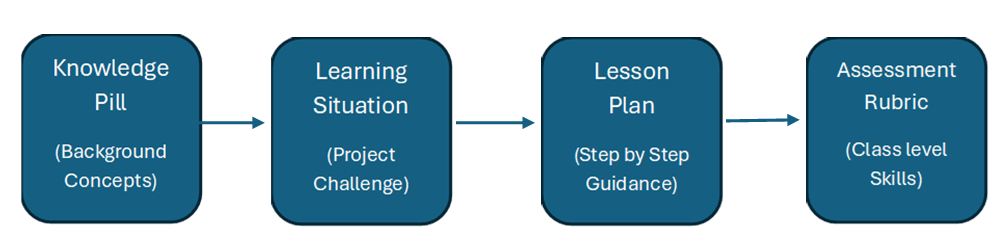
Students begin by exploring the topic through the Knowledge Pills, which provide the essential background, key concepts and real-world context needed to understand the issue. They then engage with a Learning Situation, which presents a concrete urban challenge and invites them to develop a realistic, evidence-based proposal. Throughout this process, teachers are supported by the Lesson Plan, which serves as an operational guide for structuring the work step by step, from the introduction of the topic to the development and presentation of the final outcome.
In this way, the YSC methodology supports a coherent problem-based learning process that helps students address authentic sustainability challenges while developing key competences such as critical thinking, creativity, digital competence, collaboration and empathy.
1. Understanding the YSC Learning Packages
In the Young Smart Cities project, each learning unit is structured as a Learning Package comprising three elements: the Knowledge Pills, the Learning Situation and the Lesson Plan.
The Learning Package is designed to guide students from essential background knowledge to the development of a concrete, evidence-based solution. Each component plays a distinct role, and together they support a complete problem-based learning process.
At the end of this process, the Skills Assessment Rubric is used to evaluate students’ work.
a) Knowledge Pills – The introduction to the topic > open
Knowledge Pills provide students with the foundational understanding they need before beginning their project work.
Each Knowledge Pill offers a structured and multi-layered overview of the topic, combining clear explanations, real urban examples, data, visuals and curated multimedia resources. Their purpose is to build a solid conceptual base without becoming a chapter to be “studied” in a traditional sense: students use them to grasp the key issues, stakeholders and challenges linked to the topic.
Importantly, the Knowledge Pills in the YSC pathway were developed directly by the YSC partner schools, through collaboration between teachers and students. This ensures that the materials are accurate, meaningful and closely connected to real urban contexts, while remaining accessible and engaging for learners.
b) Learning Situation – The problem to be solved > open
The Learning Situation presents a specific real-world problem and frames it through a clear driving question.
It describes the scenario in which students will work and outlines the task they are expected to complete to develop a realistic, well-reasoned proposal. Each scenario is directly linked to the topic introduced in the corresponding Knowledge Pill: while the Knowledge Pill provides the broader background and key issues within the topic. The task describes what students are expected to do: explain how students should work and the objectives they are expected to achieve, as well as the characteristics their proposals should have.
Learning Situations are intentionally broad and give students the freedom to choose different areas of investigation while maintaining a clear focus on producing a well-reasoned and realistic proposal. Some Learning Situations also offer optional alternative pathways that focus on more specific local challenges. All Learning Situations in YSC didactic packages have been developed by the schools, in cooperation with external partners—most often local authorities or companies—to ensure that the problems are meaningful, feasible and closely connected to the urban reality.
The description above refers to the full didactic version of the Learning Situation intended for teachers, which includes the complete scenario, the driving question and all pedagogical instructions. In addition to this, under “Solve” on the platform, you will also find the student version of each Learning Situation. This simplified version presents only the driving question and the task(s) and is written in clear language for students to follow during their project work.
c) Lesson Plan – How to guide the work step by step > open
The Lesson Plan is the teacher’s operational guide and translates the Learning Situation into a sequence of concrete classroom activities.
It organises the learning process into clear phases—from exploring the topic, to conducting research and analysis, developing solutions, and preparing the final product. Its purpose is to support teachers in leading a coherent and well-paced problem-solving journey.
At the end of the activity, students present their final proposal—whether a document, presentation, video, prototype or another format specified in the Lesson Plan. The expectation is that the final product offers a plausible, well-reasoned solution grounded in local observations or data and developed through meaningful collaboration.
d) Skills Assessment Rubric > open
The learning pathway concludes with an assessment carried out using the Skills Assessment Rubric.
Teachers may, of course, evaluate students’ work according to their usual school criteria. In addition, they are asked to conduct an assessment focused on the skills identified by the project: Critical Thinking, Creativity & Innovation, Digital Competence, Exploratory Thinking & Collaboration, and Empathy & Value-based Thinking.
This assessment is conducted using the rubric and refers to the class’s final product, not to individual students. The Skills Assessment Rubric does not evaluate content knowledge; instead, it focuses on the competences demonstrated through the completed project. For each applicable competence, the teacher selects the level achieved (Inadequate – Basic – Advanced) and submits the completed rubric to the YSC team.
2. Resources for Teachers
On the platform (Teacher Training section), teachers can access methodological resources in the form of short training videos that support the implementation of the YSC Learning Pathway. All training videos are available in English, but teachers can activate automatic subtitles and translation through YouTube, which allows the content to be viewed in different languages.
a) PBL Training – A brief introduction for teachers > open
The Young Smart Cities PBL Training consists of seven short videos designed to introduce teachers to the core principles of problem-based learning, a method that originated in vocational education. The training explains why contemporary teaching should go beyond the transmission of content and instead strengthen students’ ability to tackle real, complex and open-ended problems responsibly and creatively.
A central theme is Outcome Orientation—an educational mindset that focuses not only on what students learn, but on what they are able to do with that learning in real-life situations. This approach is especially relevant in the age of artificial intelligence: only by reinforcing complex, critical and creative competences can we prepare young people to face new, uncertain and non-standardised challenges.
The training also illustrates what makes a strong PBL case, how to select authentic problems with genuine project potential and how to guide students through the holistic action cycle: informing, planning, executing, monitoring and reflecting. It further explains how macro-, micro- and meso-analysis can help teachers evaluate whether a problem is suitable for a project-based learning pathway.
Finally, the training introduces COMET, a competence-based assessment tool designed to evaluate PBL outcomes and the quality of the solutions developed by students. The YSC Learning Pathway draws on this methodology and integrates it with the project’s five key competences, captured in the Skills Assessment Rubric used for assessment.
b) Skills Based Training > open
The Young Smart Cities Skills Based Training covers five essential skills for students and educators in project-based learning. Each skill is introduced through three short videos designed primarily for teachers, accompanied by practical ideas and ready-made activities to apply the skill in the classroom.
For each skill, the first video introduces the concept and its relevance to project-based learning. The second video focuses on practical strategies and classroom activities, including project-based approaches. The third video emphasizes reflection and assessment, showing ways to measure skill development and support ongoing learning. Students can also use the videos on the platform, since these provide clear explanations, simple examples and short challenges for them. This allows students to explore the concepts independently, practice the skills in project-based tasks, and reflect on their own learning.
The videos on empathy focus on why this skill supports successful project-based learning, and how it contributes to a safe, collaborative classroom climate. They offer practical ways to strengthen trust and group cohesion. The creativity videos highlight how imaginative thinking can expand students’ possibilities during project work. They give teachers concrete strategies to create a classroom environment where experimentation and expression feel accessible and encouraged. The critical thinking videos emphasise the role of analysis and questioning in inquiry-based work. They help teachers spot natural moments in a project where students can compare information, evaluate ideas and make their reasoning clearer. The videos concerning digital literacy outline its value for research, communication and safe participation in online spaces. They support teachers who want clear strategies to help students navigate the digital world and use technological tools responsibly. The last set of videos is dedicated to exploratory thinking and collaboration. They show how curiosity and teamwork reinforce each other throughout the project process. These videos support teachers in fostering open questioning, shared decision-making, and productive collaboration for deeper learning.
c) Curriculum Mapping Documents > open
In addition to the training resources, teachers can access a set of Curriculum Mapping Documents developed for each partner country (Germany, Italy, Poland and Spain).
These documents provide an overview of how the YSC Learning Packages can be integrated into national school curricula by identifying the subjects and disciplines where the content is most relevant. Their purpose is to support teachers in embedding the YSC activities within their regular teaching practice, making it easier to connect project-based learning with existing curricular requirements.
3. The YSC platform
The Young Smart Cities platform begins with the home page and is designed for simple, straightforward navigation. At the top of every page on the platform, you will see several headings.
Each of these headings represents a different part of the teaching and learning approach, discussed in the sections above. Under “Learn” you will find all of the Knowledge Pills and under “Solve” you will find all of the Learning Situations.
There is also a “Teacher Portal”. Here, you will find a drop down menu with three sections: the first is this “Guidebook” which has a guide explaining how to use the platform, the second is “Teacher Training”, which is where you will find the videos mentioned above, and the last is “Lesson Plans” where you will find the lesson plans.
In addition to these, the drop-down menu also includes a section with the full Learning Situations for teachers, containing the complete didactic explanation of each scenario, and a section with the Skills Assessment Rubric used to evaluate students’ competences at the end of the pathway.
Registration is required to fully enjoy the platform. If you experience any difficulties, please use the “Contact” section to get in touch with us.