
A technical school in Rwanda has adopted the Young Smart Cities approach to tackle a problem right on its own campus. It is a sign that Project-Based Learning speaks a universal language.
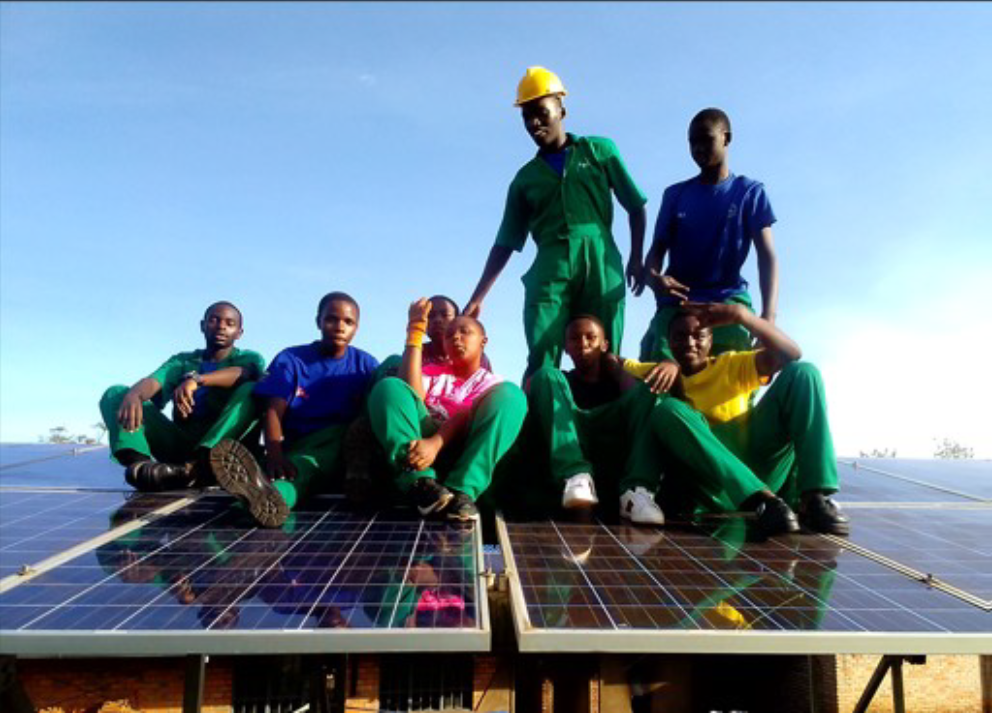
On the roofs of Nelson Mandela Technical Secondary School (NMTSS), in Bugesera District, Rwanda, more than 100 solar modules generate clean electricity for a school that operates entirely off-grid. The school relies on its solar energy system to meet its electricity needs, demonstrating how renewable energy can support sustainable development in technical education.
Yet, a few metres away, in the school kitchen, meals for more than 400 students, both boys and girls, are still cooked over wood fires.
This is the paradox a group of Rwandan students has decided to solve, and they are doing it with Young Smart Cities.
An Idea That Travelled South
Young Smart Cities was designed for schools across Europe. But when Nelson Mandela TSS discovered the project, its teachers saw something they were looking for: a way of teaching that puts students in charge of real problems, encourages creativity and teamwork, and connects the classroom to the world outside it.
The interest from Rwanda is no coincidence. The country has made innovation, green energy and skills development for young people central to its development goals. Its technical schools are looking for teaching methods that match those ambitions.
Nelson Mandela TSS is already demonstrating its commitment to this vision. With its off-grid solar power system and its technical training programmes, the school is transitioning into a Centre of Excellence in Renewable Energy, preparing young people with the knowledge and practical skills needed to contribute to the green energy transition.
For the school, Project-Based Learning felt like the natural next step: an opportunity to turn its own sustainability challenges into meaningful learning experiences.
The School as the Client
The students’ Learning Situation, Cooking with the Sun, starts from a simple question with no simple answer: how can the school use its surplus solar energy to replace wood in its kitchen, in a way that the people who cook there every day will actually embrace?
The challenge is particularly relevant at Nelson Mandela TSS. Despite having more than 100 solar modules on its roof and operating entirely off-grid, the school still faces the challenge of finding sustainable ways to prepare meals for its community of more than 400 students.
The answer is not only technical. Clean cooking projects often fail not because the technology does not work, but because people do not adopt it. So the students will step out of the classroom and interview the kitchen staff about their habits, doubts and expectations before proposing anything.
They will explore possible solutions, considering the available energy, suitable cooking appliances, practical kitchen needs, costs and environmental benefits. Their goal is to develop a realistic proposal that the school can evaluate and potentially implement.
Learning by Competing, Deciding by Debating
The format is as creative as the question. Working in teams, the students face four challenge rounds on energy, appliances, people, and costs and the environment.
In each round, the teams compete to convince a “Decision Panel” of classmates, who play the role of the school’s decision-makers. The winning ideas from each round become the class’s shared proposal for the school.
It is learning that feels less like a lesson and more like a real project. Students act as engineers, researchers, negotiators and decision-makers. They develop technical knowledge while strengthening their communication, teamwork, critical-thinking and problem-solving skills.
Most importantly, they learn that technical solutions must respond to real needs, available resources and the people who will use them.
A Conversation That Goes Both Ways
For Young Smart Cities, the experience is just as valuable. A school in Rwanda that runs entirely on solar energy, serves more than 400 students and is transitioning into a Centre of Excellence in Renewable Energy has a great deal to share with European classrooms about what sustainable energy looks like in practice.
The project also demonstrates how Project-Based Learning can connect education with local development priorities. By working on a challenge within their own school, students see how their technical skills can contribute to reducing dependence on firewood, protecting the environment and improving everyday life.
The story is not over. When the project is complete, the Rwandan students will take over this blog to tell, in their own words, what they discovered, the solutions they considered and what they proposed to their school.
At Nelson Mandela TSS, the sun already powers the school. Now, students are exploring how it could help power the school kitchen, too.
Stay tuned!