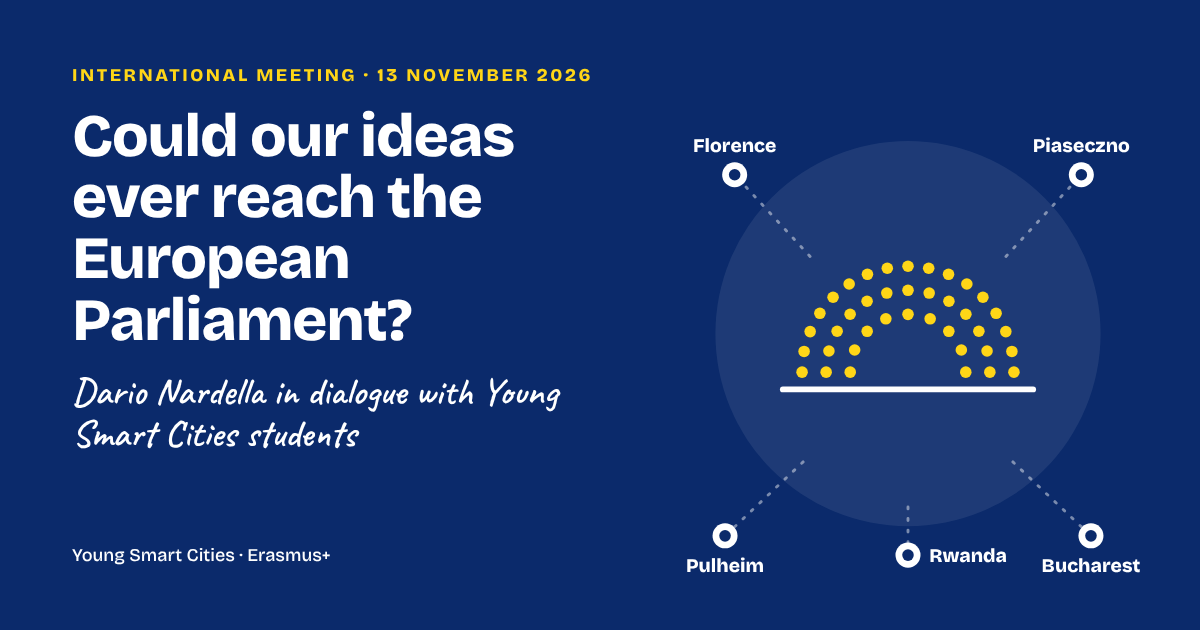
Students from five countries put their questions to Dario Nardella, former Mayor of Florence and now a Member of the European Parliament. His answer: Europe helps cities with money, rules and networks, but change starts with the street outside the school.
The question came from a student at Scuola Santa Maria degli Angeli in Florence, and it was not a polite formality. Could his class’s ideas for the Cascine, the city’s largest park, ever reach the European Parliament? Dario Nardella did not hesitate: “Yes, and I mean it.”
On Friday 13 November, for an hour and a half, Nardella joined the schools of the Erasmus+ project Young Smart Cities online: Florence, Piaseczno in Poland, Pulheim in Germany and, as guests, a school in Rwanda and one in Bucharest. More than 50 connections were online, many of them whole classes following from their classrooms. Mayor of Florence from 2014 to 2024 and an MEP since 2024, he faced an audience that had spent three years working on cities, and had come with questions of its own.
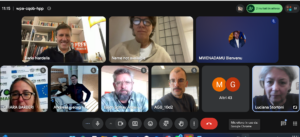
Dario Nardella with the teachers and moderators of Young Smart Cities at the end of the meeting, 13 November 2026.
Cities: the problem and the solution
Nardella opened with a figure: cities produce 80% of Europe’s CO₂ emissions and consume 80% of its energy. But they are also where the solutions are found, he added. Most Europeans live there, universities and research centres are there, and new models of mobility and inclusion are tested there. He saw this as president of Eurocities, the network of more than 200 large European cities that he led from 2019 to 2022.
This is exactly where Young Smart Cities began three years ago, recalled Pia Lovengreen Alessi of Fondazione AEM. The schools went out into their cities, identified real problems with local authorities and companies, and designed solutions through problem-based learning.
Opening the meeting, project coordinator Prof. Ralph Dreher of the University of Siegen gave the credit to the students, who had been willing to discuss, experiment and sometimes fail, and to the teachers who had stepped outside the familiar curriculum to teach across subjects. Projects like this, he argued, keep European education from sliding towards pure economic usefulness. He borrowed an ancient saying, “Education is not the filling of a vessel, but the kindling of a flame”, and gave it a Young Smart Cities twist: the real question is how that flame can be decarbonised.
Florence’s ideas
The two Florentine schools, Istituto San Giuseppe and Santa Maria degli Angeli, showed their former mayor the city they would like to live in. To encourage walking and cycling, the PassoPasso app rewards students with 10 cents for every 500 metres to school on foot or by bike, and its anonymous data shows the city where new cycle lanes are needed. The Cascine Giovani app would hand parts of the park to schools and associations in turns, for sport, study and music, on the principle that a lively space is a safe space. And small QR code signs next to plants would tell passers-by what they are looking at, with no app needed.
Nardella called the projects smart and rooted in the city’s real needs, and said the Municipality of Florence should take them seriously.
Money, rules, people
Students from Istituto San Giuseppe reminded him of one of his decisions as mayor: Florence joining the EU Mission for 100 climate-neutral and smart cities. What is Europe doing today to make cities greener and help people get around without cars?
Nardella’s answer started from a lesson he learned in office: cities cannot do it alone. A tramline, a network of cycle lanes or a new park costs a lot of money and takes years. Europe steps in in three ways:
- Cohesion Funds, Horizon Europe and the European Investment Bank co-finance public transport, cycling infrastructure and the renovation of school buildings.
- Large cities must adopt Sustainable Urban Mobility Plans that put walking and public transport first.
- The new Social Climate Fund helps families who cannot afford a new car or are struggling with high energy bills.
Pulheim: young people and local politics
At the Abtei Gymnasium in Pulheim, near Cologne, the 10th graders started from a blunt question: how do young people really feel about local politics, and how would they like to take part? They spent three days learning how the European Parliament works and how the EU involves citizens, then split into groups on local issues such as safety and public spaces. They wrote surveys, ran them across the school and analysed the answers.
The results turned into digital ideas: interactive maps, SOS safety apps, meet-ups organised through social media, and an app, now being programmed, that connects young people with local politics. Other teams used geographic information systems (GIS) to plan longer public transport routes into the town centre, better roads and pavements, and new sports and leisure spaces for all ages.
Discontent is beaten by things you can touch
Their first question was the hardest of the morning. What chance do individual proposals have of becoming reality at a time of growing political discontent?
Nardella did not sugar-coat it: it is hard, harder than ten years ago. Many people feel the green transition is imposed from above, costs them money and complicates their lives, and that feeling has to be taken seriously. From ten years as mayor he drew three lessons:
- Start with tangible things. A tree-lined street, a safer route to school or a pedestrian square convinces people more than any document about 2030.
- Show the everyday benefits: cleaner air for children, lower bills, less time stuck in traffic.
- Involve citizens from the start, not at the end. In Florence, he said, changes made without explanation led to protests. The same projects, designed together with residents, shopkeepers and students, were accepted.
Projects like the students’, tested on real streets, are in his view the best answer to discontent.
“If I were mayor again”
Their second question turned the tables: if he were a mayor again, what decision would he make together with young people, using their participation app?
Nardella chose school streets. He would ask every student to map their route to school, flagging unsafe spots, missing cycle lanes, illegal parking and the lack of shade. With that map the city would decide which streets in front of schools to close to cars at the start and end of the school day, and redesign them with trees, benches and places to meet.
Then he went further: he would give young people a real share of the city’s investment budget. An app with no influence on decisions, he explained, only breeds frustration. Participation is credible only when it has consequences.
Piaseczno: a hero’s house and tomorrow’s jobs
Tadeusz Zawadzki was 22 when he was killed in 1943. Known as “Zośka”, he was a young scout of the Szare Szeregi, the Polish wartime resistance, and a hero of Kamienie na szaniec, a novel generations of Polish teenagers have grown up with. Class 8D from PALO went on their own to his family’s wooden villa in Zalesie Dolne to find out who he really was.
The visit was no detour from the project. Zośka’s House is a case study in giving old buildings new life: restored as a small museum, with information boards for passers-by and an entrance accessible to wheelchair users, it remains part of the town’s daily life. It is the same idea behind the QR codes the Florentine students want on the historic buildings of the Cascine.
The future came next, and it came with the mayor. Daniel Putkiewicz told the class how Piaseczno is changing, and the students worked out which jobs their town will need. Their ideas became posters, and then fuel for an Oxford-style debate in which older students argued over what artificial intelligence will do to work.
One question tied it all together: what would a city look like if people really cared about each other? After a quiz and a film on empathy, the class asked AI to picture it: green, open to everyone, with technology working for residents.
Nardella called Zośka’s House a powerful symbol of Polish history and placed the debate on AI and work among the crucial challenges ahead. He also praised the class’s English and spoke warmly of Poland, where as Mayor of Florence he worked on many projects with the Mayor of Warsaw.
Rwanda: a school with the sun on its roof
The most technical presentation of the morning came from 6,000 kilometres south. At Nelson Mandela Technical Secondary School in Rwanda’s Bugesera District, 24 electrical technology students set out to solve a paradox. Their school has a 45 kWp solar installation but uses less than a fifth of the energy it produces. More than 52,000 kWh a year go unused, while the kitchen still burns a cubic metre of firewood every day to feed over 400 students.
The cost is more than money: 266 cubic metres of wood a year, up to 400 trees, eight hours a day of heavy work, smoke in the kitchen and injuries from chopping logs. Nor is the school an exception: across Rwanda, school meals for about 4.8 million learners are cooked with firewood. In four rounds of problem-based learning, the students measured the surplus, chose five efficient electric cookers and calculated the impact. Their answer is Cooking with the Sun: cookers that would pay for themselves in just over four years and avoid around 490 tonnes of CO₂ equivalent a year.
Nardella saw in it a school serving its whole community, saving energy, money and forests. He pointed to Global Gateway, the EU programme that can fund joint clean energy projects between Europe and Africa, and suggested staying in touch.
Bucharest: citizens who make their own energy
The Aldo Moro School in Bucharest worked on prosumers: citizens who produce the energy they use, with solar panels on homes and schools, and share it through energy communities. Their two questions, read out by the moderator, went straight to the point.
The first: would it be useful to plant trees in every school garden? “Yes, absolutely,” Nardella replied. Paris, Barcelona and Florence are turning asphalt schoolyards into climate shelters. His advice: the right tree in the right place, and every class should adopt one, give it a name and look after it as it grows.
The second: how can Europe persuade the rest of the world to waste less energy? Not with speeches, he said, but with example, investment and shared technology. And with cities, which connect across continents faster than governments do.
Write to your mayor
To the students from Piaseczno, and through them to everyone, Nardella pointed out two doors into Europe. One is the European Youth Event, which brings thousands of young people to Strasbourg every two years. The other is Euroscola, where school classes take the seats of the European Parliament for a day. He invited all the schools to send their proposals on urban green spaces to his office, and promised to read them. He also reminded them that any EU citizen or resident, students included, can submit a petition to the European Parliament on matters within the EU’s competence, and that the Petitions Committee examines every one it receives.
His closing message was a call to keep going. Mapping streets, studying their neighbourhoods, asking politicians difficult questions: the students, he said, have already started. And when someone tells them their ideas are unrealistic, they should remember that a few years ago the mission of 100 climate-neutral cities also seemed unrealistic. Today those cities work on it every day.