
Rice, beans, maize meal and porridge: matching every dish to an electric cooker and a dedicated solar array.
Having surplus solar energy is only the first step; matching thermal energy requirements with microgrid circuit limits is essential. In Round 2 and 3, students mapped equipment specifications directly against daily menu volumes for 400+ students (75 kg of rice, 55 kg of beans, maize meal, and porridge).
The five commercial electric cookers were distributed across the three existing solar systems as follows .:
| Inverter System | Allocated Equipment | Menu & Food Quantities | Daily Load | Operating Margin |
| Fronius System (10 kWp PV, 20 kW AC) |
3 × Rice Steamers (25 kg / 4 kW each) |
Rice (75 kg total / day) | 12.0 kWh/day | 26.3 kWh/day surplus |
| Victron System (8 kWp PV, 48V Battery) |
1 × Pressure Cooker (80 L / 5 kW) |
Beans (55 kg / 180 L water) | 22.5 kWh/day | 1.0–5.5 kWh/day surplus |
| Deye System (27 kWp PV, 520V Battery) |
1 × Multifunction Cooker (200 L industrial) |
Maize flour (30 kg), porridge (8 kg) & sugar | 48.0 kWh/day | 8.9–35.0 kWh/day surplus |
Combined, the five cookers require 82.5 kWh per operating day (~22,000 kWh across 266 school days)—consuming less than 42% of the available 52,606 kWh net annual surplus.
Appliance selection is critical for efficiency: commercial pressure cookers drastically reduce bean cooking times, while insulated steamers prevent heat dissipation . Each cooker connects to its system’s AC distribution board via dedicated isolators, enabling seamless isolation without disrupting overall school power .
| “We carefully calculated the peak loads for each appliance and added dedicated isolators on the AC distribution boards. This ensures that the kitchen staff can safely operate or service any cooker independently without tripping the rest of the school’s electrical grid.” — Patrick Gisubizo, Group Leader . |
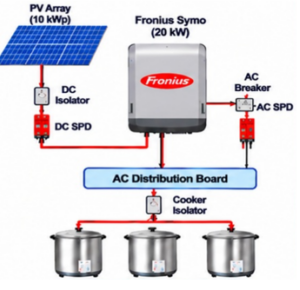
: Electrical block diagram