
The Nelson Mandela case is not an exception. It is the rule in Rwanda’s schools.
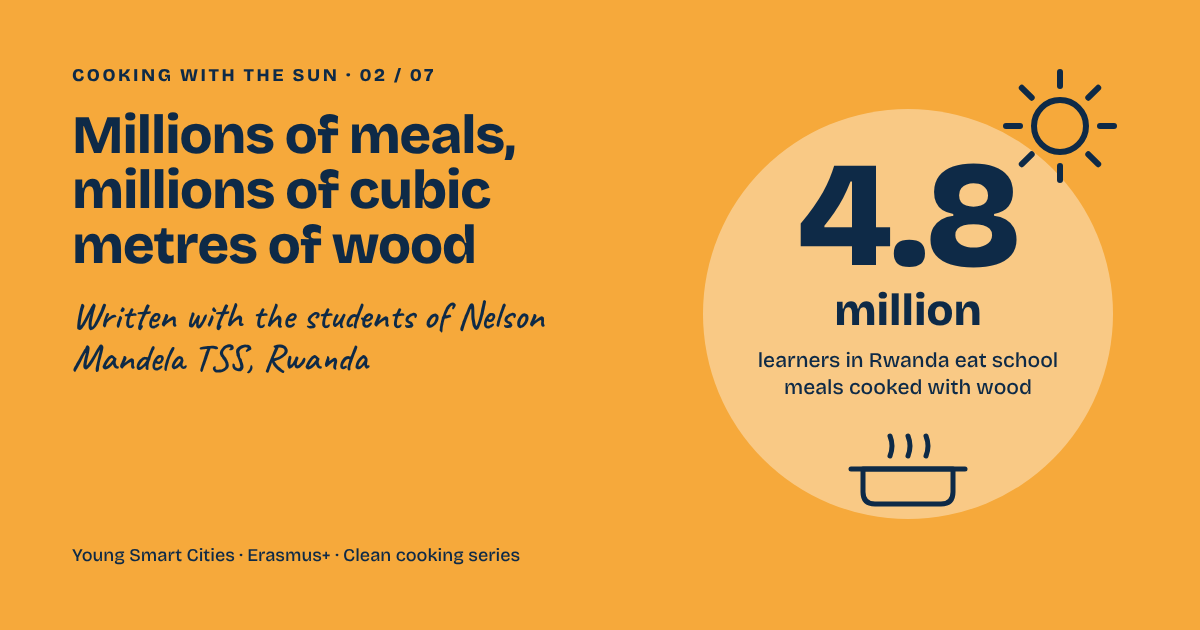
In Rwanda, almost all school canteens rely on firewood for daily meal preparation. According to baseline estimates gathered by the students, about 4.8 million learners across the country receive school meals cooked with wood, consuming around 2 million cubic metres of wood every year.
The operational challenges are identical across institutions:
- Rising Costs: Firewood prices continue to escalate, placing severe ongoing strain on institutional budgets.
- Severe Air Pollution: Dense smoke fills kitchen spaces, exposing staff to high levels of fine particulate matter (PM₂.₅) and carbon monoxide.
- Deforestation & Carbon Footprint: Continuous biomass harvesting contributes to local forest degradation and greenhouse gas emissions.
- Labor Strain & Injuries: Carrying heavy timber logs and chopping firewood leads to frequent injuries and chronic physical exhaustion.
At the same time, many educational institutions across Rwanda have installed solar PV infrastructure. However, these systems often generate far more power than required for basic lighting, computers, and workshops, leaving a substantial surplus unutilized.
The Nelson Mandela project proves that these two challenges answer each other. A school with existing solar capacity can redirect its surplus energy to clean electric cooking. No additional power generation is needed—only efficient commercial electric appliances and precise electrical load matching.
This project represents far more than one school’s solution; it provides a practical, technical model that secondary and vocational schools across Rwanda can study and replicate.
| “This project is entirely modular. Because technical and vocational schools across Rwanda face the exact same energy surplus and biomass costs, our students’ blueprint can be seamlessly replicated nationwide.” — Moise Kwizera, Department Supervising Teacher |
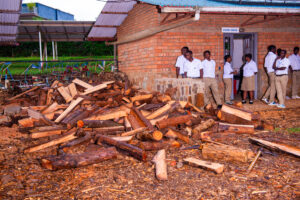
:Wood fuel for cooking